Search & AI Visibility

Website & SEO Audit

A website audit that finds exactly why your site doesn’t convert — technical, on-page, speed and tracking issues, ranked by impact.

Current offer
Fee credited

Deep SEO Audit

Know exactly why you're not ranking

₹1,999*incl. GST
  • Technical, on-page and backlink review
  • Competitor and keyword gap analysis
  • Speed, indexing and schema checks
  • Prioritised fix list with effort levels
  • Fee credited if you hire me after

*Prices are starting points for a typical scope — I confirm your exact quote after a short call. GST, third-party tools and ad spend are billed separately. T&C apply.

Sound familiar?

The problems I fix.

01

Visitors arrive and leave without a trace.

02

Your site scores badly and nobody knows which fix matters.

03

Forms, events or purchases aren't tracking properly.

What you get

Everything done, not just recommended.

Technical crawl

Broken links, redirects, indexation, duplicate content.

Speed & CWV

LCP, CLS and INP diagnosis with concrete fixes.

On-page SEO

Titles, headings, schema and internal linking.

Conversion review

Hero clarity, form friction, trust signals, mobile flow.

Tracking check

GA4 events, GTM tags and conversion accuracy.

Priority list

Every issue scored on impact versus effort.

organic traffic for a B2B brand in 6 months
0 ×
more student inquiries via SEO + paid search
0 %
years of hands-on delivery
0 +
Website & SEO Audit offers

Pick a starting point. Upgrade any time.

Fee credited

Deep SEO Audit

Know exactly why you're not ranking

₹1,999*incl. GST
  • Technical, on-page and backlink review
  • Competitor and keyword gap analysis
  • Speed, indexing and schema checks
  • Prioritised fix list with effort levels
  • Fee credited if you hire me after

*Prices are starting points for a typical scope — I confirm your exact quote after a short call. GST, third-party tools and ad spend are billed separately. T&C apply.

How it works

A clear process, run in the open.

01

Access

Analytics, Search Console and site access.

02

Audit

Automated crawl plus manual page-by-page review.

03

Report

Written findings and a recorded walkthrough.

04

Fix support

Optional implementation with your developer.

Tools I use:Screaming FrogGA4Search ConsoleGoogle Tag ManagerSEMrush
The complete guide

Website audit: the complete guide.

Everything worth knowing before you invest — what’s included, costs in India, timelines, mistakes to avoid and how to measure results. Open any chapter.

12 chaptersAbout 7 min readWritten by Jugal Kishore ShuklaUpdated October 2026
What a website audit covers

A website audit is a structured health check that answers two questions: why isn't the site ranking, and why isn't it converting? My SEO audit looks at the site the way Google does and the way your customers do — then turns the findings into a prioritised fix list.

  • Technical SEO audit: crawling, indexation, duplicate and thin pages, redirects, canonical tags, sitemaps and robots rules.
  • Speed and Core Web Vitals: what slows your pages on real phones, and what to change first.
  • On-page SEO: titles, headings, content depth, internal linking and keyword cannibalisation.
  • Structured data: missing or broken schema for your organisation, services, products, FAQs and reviews.
  • Backlink profile: toxic links, lost links and the authority gap to competitors.
  • Tracking: whether GA4, Tag Manager and conversion events are actually recording leads.
  • Conversion: forms, calls to action, trust signals and page flow that lose visitors.

The output is not a generic tool export. Every issue has an explanation, an impact rating and an effort estimate, so you know exactly what to fix first.

When you need a website audit

An SEO audit is the right first step when:

  • Traffic or leads dropped and nobody knows why — after a redesign, migration or Google update.
  • You are about to redesign or migrate and want to protect what already ranks.
  • You have invested in SEO or content for months with little to show for it.
  • You are hiring an agency or freelancer and want an independent baseline first.
  • Ads are expensive and you suspect the website, not the campaigns, is the problem.

It is less useful for a brand-new site with a handful of pages and no history — there, a solid build checklist does more than an audit. For everything else, a website audit is the cheapest way to stop guessing.

How I run a website audit
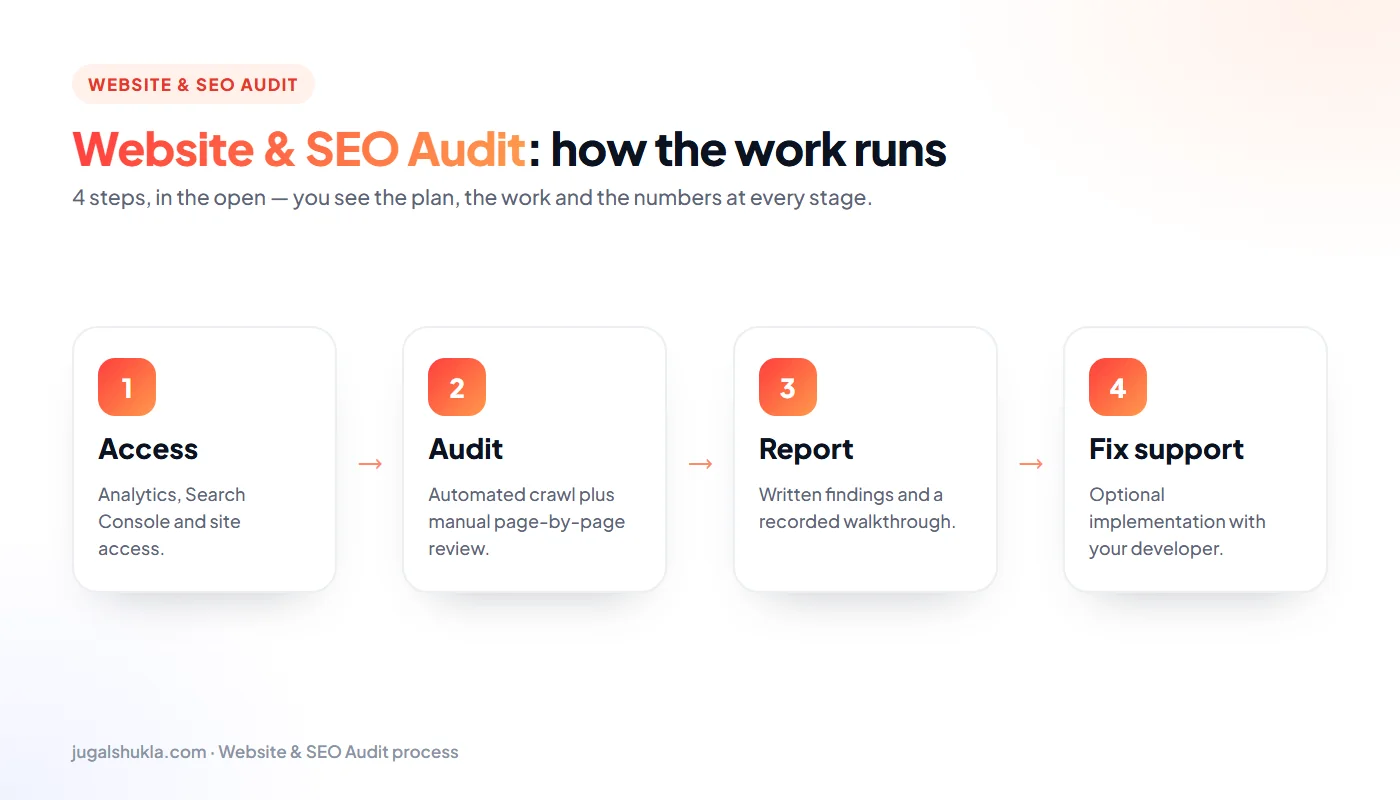
Website audit process: Access → Audit → Report → Fix support
How a Website & SEO Audit engagement runs, step by step.
  1. Access. Read access to Search Console, GA4, Tag Manager and your website (or a staging copy).
  2. Audit. A full crawl, indexation and log review, speed testing on real devices, schema validation, backlink review, competitor comparison and tracking verification.
  3. Report. A clear document in plain English: what is wrong, why it matters, how to fix it, and in what order — plus a short video walkthrough.
  4. Fix support. Specific tickets for your developer, or I implement the fixes myself if you prefer.

Most audits take five to seven working days. Critical issues — like pages accidentally blocked from Google — are flagged the day I find them.

What an SEO audit costs

Website audit pricing in India ranges from free automated reports to ₹50,000+ for large enterprise technical SEO audits. Automated reports list hundreds of "issues" without telling you which matter; a useful audit is the opposite — fewer findings, clearly prioritised.

My Deep SEO Audit is ₹1,999* for a typical business website. It includes the technical, on-page and backlink review, competitor and keyword gap analysis, speed, indexing and schema checks, and a prioritised fix list with effort levels. If you hire me for SEO afterwards, the fee is credited in full.

Large e-commerce stores or sites with thousands of pages get a custom quote, because crawling and analysing them takes considerably longer. You can also start with the free Website SEO Grader to see your top issues in 30 seconds.

What results to expect after an audit

An audit does not improve anything by itself — the fixes do. In my experience:

  • Critical technical fixes (indexation, redirects, canonical errors) often recover traffic within two to six weeks.
  • Speed improvements lift conversion rates quickly and support rankings over time.
  • Tracking fixes immediately improve decision-making, and for Google Ads users, smart bidding.
  • Content and cannibalisation fixes take one to three months to show in rankings.

The biggest result is clarity: you stop spending on the wrong things. Many businesses discover their real problem is not "more SEO" but a handful of technical errors or a broken lead form.

The issues I find in almost every audit
  • Pages excluded from Google by mistaken noindex tags, robots rules or canonical tags.
  • Duplicate URLs — http and https, www and non-www, filters and parameters — splitting authority.
  • Redirect chains and broken links left over from redesigns.
  • Slow mobile pages caused by oversized images, heavy themes and too many scripts.
  • Keyword cannibalisation between blog posts and service pages.
  • Missing or invalid schema.
  • Broken conversion tracking, so nobody knows which channel produces leads.
  • Weak calls to action and forms that ask for too much.
Post-redesign and migration audits

The most expensive SEO problems I see happen during a redesign or platform migration. A new design launches, everything looks better — and organic traffic falls by a third because old URLs were not redirected, content was trimmed or tracking stopped working.

A migration-focused website audit has two parts:

Before launch

  • A full inventory of every URL that ranks, earns links or brings traffic.
  • A one-to-one redirect map from old URLs to the most relevant new pages.
  • Checks that titles, headings, content depth, schema and internal links carry over.
  • Tracking verified on the staging site before it goes live.

After launch

  • A crawl of the live site to confirm redirects, canonical tags and indexation.
  • Daily Search Console monitoring for the first weeks.
  • A comparison of rankings and leads against the pre-launch baseline.

If your traffic dropped after a recent redesign, a technical SEO audit is usually able to find the cause quickly — and most losses are recoverable when fixed early.

A sample of what the audit report looks like

Every finding in my website audit follows the same structure, so it is easy to act on:

  • The issue: for example, "42 product URLs canonicalise to the category page".
  • Why it matters: "Google treats these products as duplicates and does not show them in search results."
  • Evidence: the affected URLs, screenshots and Search Console data.
  • The fix: precise instructions a developer can follow — or the exact setting to change in WordPress or Shopify.
  • Impact and effort: rated High, Medium or Low, so the order of work is obvious.

The report opens with a one-page summary: the five fixes that will make the biggest difference, in order. Most clients act on those first and come back to the rest later.

A short screen-recorded video walks through the findings in plain language, so your team understands the why, not just the what.

Questions to ask before you buy an SEO audit
  • Is it manual or just a tool export? Tools find symptoms; an experienced auditor finds causes and priorities.
  • Does it include tracking? An SEO audit that ignores broken GA4 or conversion tracking misses half the picture.
  • Will I get developer-ready instructions? Vague recommendations stall in the backlog.
  • Does it cover speed on real devices? Lab scores alone can mislead.
  • Is there a walkthrough? A 20-minute explanation saves weeks of confusion.
  • What does it cost if I want help with the fixes? Ask before, not after.
Your website audit checklist

Before booking a technical SEO audit, you can check a few basics yourself in under an hour:

  • Search site:yourdomain.com in Google — are your key pages listed?
  • Open Search Console's Pages report — how many pages are "Not indexed", and why?
  • Test your homepage and top service page on PageSpeed Insights from a phone.
  • Check that only one version of your site loads (https, with or without www) and the others redirect.
  • Submit your own contact form and confirm the enquiry arrives and is tracked in GA4.
  • Look for two pages targeting the same main keyword.
  • Check that every important page has a unique title and meta description.

If several of these raise questions, a full website audit will turn them into a clear, prioritised plan — and it is the most affordable way to stop guessing about why the site underperforms.

What happens after the audit

An audit is the beginning of the work, not the end. After the walkthrough you can choose how to proceed:

  • Your team fixes it: you get developer tickets and I answer questions as they work through them.
  • I fix it: I implement the technical and on-page fixes directly, usually within two to four weeks.
  • Ongoing SEO: the audit becomes month one of an SEO engagement, and the audit fee is credited.

Thirty days after the fixes go live, I re-crawl the site and compare indexation, speed and tracking with the original baseline, so you can see exactly what the SEO audit delivered.

How to measure the impact of audit fixes
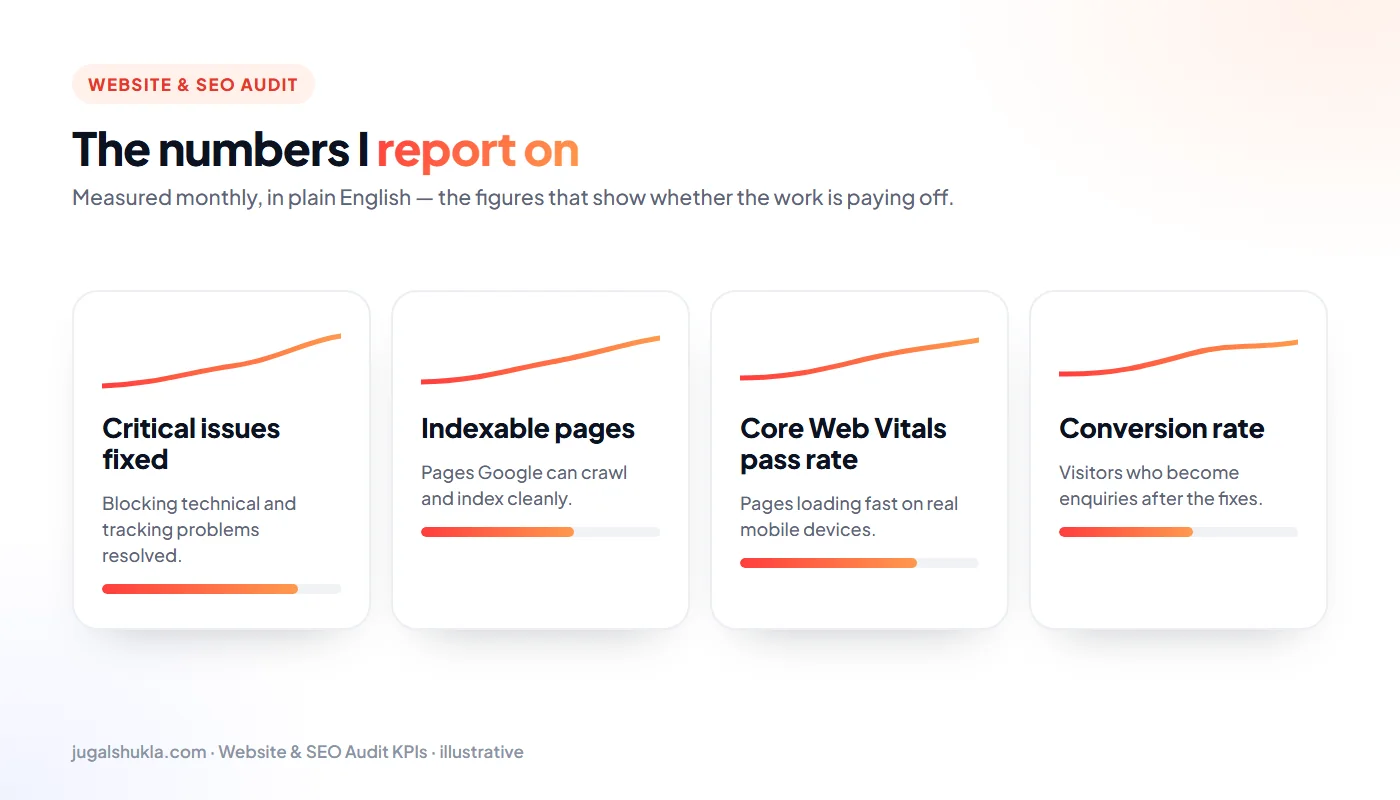
Website audit KPIs: Critical issues fixed, Indexable pages, Core Web Vitals pass rate, Conversion rate
The numbers I report on every month (illustrative).

After the fixes ship, I track four numbers against the pre-audit baseline:

  • Critical issues resolved — confirmed with a re-crawl.
  • Indexable, healthy pages — in Search Console's indexing report.
  • Core Web Vitals pass rate — field data on real mobile devices.
  • Conversion rate — visitors who become enquiries, measured with corrected tracking.

Quick self-check before you book: open Search Console's Pages report. If "Not indexed" is larger than "Indexed", or you have not looked in months, a website audit will almost certainly pay for itself.

FAQ

Website audit questions, answered.

11 straight answers to what people ask me most about Website & SEO Audit. Still unsure? Send a quick message — I reply within 24 hours.

Still have a question?

Ask me directly — no bots, no sales team.

How long does the audit take?

Five to seven working days for most sites.

Is there a free version?

Yes — a short free audit covering the biggest three issues.

Can my developer implement it?

That's the point. Every item is written as a specific ticket.

How long does a website audit take?

Five to seven working days for a typical business site. Critical problems are flagged as soon as I find them.

What do I get at the end of the SEO audit?

A plain-English report with every issue explained, rated by impact and effort, a prioritised fix list, developer-ready tickets and a short video walkthrough.

Is the ₹1,999 audit fee refundable?

It is credited in full if you hire me for SEO or website work afterwards.

Do you fix the issues or just report them?

Both options work. I can hand precise tickets to your developer or implement the fixes myself.

Will an audit help after a traffic drop?

Yes. I compare the drop with Google update dates, site changes and indexing data to find the cause before recommending fixes.

Can you audit a site before a redesign?

That is one of the best times. I document what ranks, every URL that needs a redirect and the content to preserve, so the new site does not lose traffic.

Does the audit include Google Analytics and tracking?

Yes — I verify that GA4, Tag Manager and conversion events record leads correctly, because decisions depend on accurate data.

What is the difference between the free SEO grader and the paid audit?

The free Website SEO Grader checks one page automatically in seconds. The Deep SEO Audit is a manual, site-wide technical SEO audit with competitor analysis and a prioritised plan.

Next step

Want a hands-on partner, not a deck?

Tell me what you’re trying to grow. I’ll tell you honestly whether I’m the right person, and what I’d do first.

Send a quick brief

I reply within 24 hours.