Growth, Automation & Brand

Branding & Brand Strategy

Positioning, message and voice defined so your ads, site and sales calls stop contradicting each other.

Current offer
Monthly

Social Presence Plan

Show up consistently and look credible

₹6,999*/month
  • A content calendar every month
  • 12 posts and 4 reels
  • Design, captions and hashtags
  • Instagram and Facebook handled for you
*Prices are starting points for a typical scope — I confirm your exact quote after a short call. GST, third-party tools and ad spend are billed separately. T&C apply.

Sound familiar?

The problems I fix.

01

Prospects can't repeat what you do.

02

Every page describes the business differently.

03

You compete on price because nothing else stands out.

What you get

Everything done, not just recommended.

Market position

Where you sit against alternatives, in one sentence.

Message house

Core promise, three pillars, proof under each.

Value proposition

Written for each audience segment.

Tone of voice

How you sound, with do/don’t examples.

Identity direction

Colour, type and imagery guidance for designers.

Rollout checklist

Where the new message goes, in order.

organic traffic for a B2B brand in 6 months
0 ×
more student inquiries via SEO + paid search
0 %
years of hands-on delivery
0 +
Branding & Brand Strategy offers

Pick a starting point. Upgrade any time.

Monthly

Social Presence Plan

Show up consistently and look credible

₹6,999*/month
  • A content calendar every month
  • 12 posts and 4 reels
  • Design, captions and hashtags
  • Instagram and Facebook handled for you
Free

Free Growth Call

30 minutes. Your numbers. A clear next step.

Freefree call
  • Funnel and channel review
  • The two or three levers to pull first
  • Honest fit check — no hard sell
  • Written summary after the call

*Prices are starting points for a typical scope — I confirm your exact quote after a short call. GST, third-party tools and ad spend are billed separately. T&C apply.

How it works

A clear process, run in the open.

01

Listen

Customer interviews and sales-call review.

02

Define

Position and message tested against real objections.

03

Document

A short, usable guide — not a 90-page bible.

04

Roll out

Site, ads and collateral updated to match.

Tools I use:SEMrushChatGPTClaude AICanvaMidjourney
The complete guide

Branding: the complete guide.

Everything worth knowing before you invest — what’s included, costs in India, timelines, mistakes to avoid and how to measure results. Open any chapter.

20 chaptersAbout 7 min readWritten by Jugal Kishore ShuklaUpdated October 2026
What branding really means

Branding is not only a logo or a colour palette. Your brand is what people think, feel and say about your business — and branding is the work of shaping that deliberately. A strong brand makes customers choose you faster, pay more willingly and recommend you more often.

Brand strategy work with me covers:

  • Brand positioning: who you are for, what you do differently and why it matters.
  • Brand story and purpose: where you came from and what you stand for.
  • Messaging: a clear one-line description, key messages and proof points.
  • Brand voice: how you sound in writing and conversation.
  • Visual direction: guidance for logo, colours, typography and imagery — working with your designer or mine.
  • Brand guidelines: a practical document your team and partners can follow.
  • Rollout: website, social profiles, Google Business Profile, sales materials and signage updated consistently.
Who needs brand strategy
  • Businesses competing mainly on price and wanting to escape it.
  • Companies that have grown and whose image no longer matches their quality.
  • New businesses wanting to start with clear brand positioning.
  • Firms with inconsistent messaging across website, social and sales.
  • Family businesses passing to a new generation and modernising.

Signs you need branding work: customers describe you differently from how you see yourself, sales teams explain the business in different ways, and marketing materials look like they come from different companies.
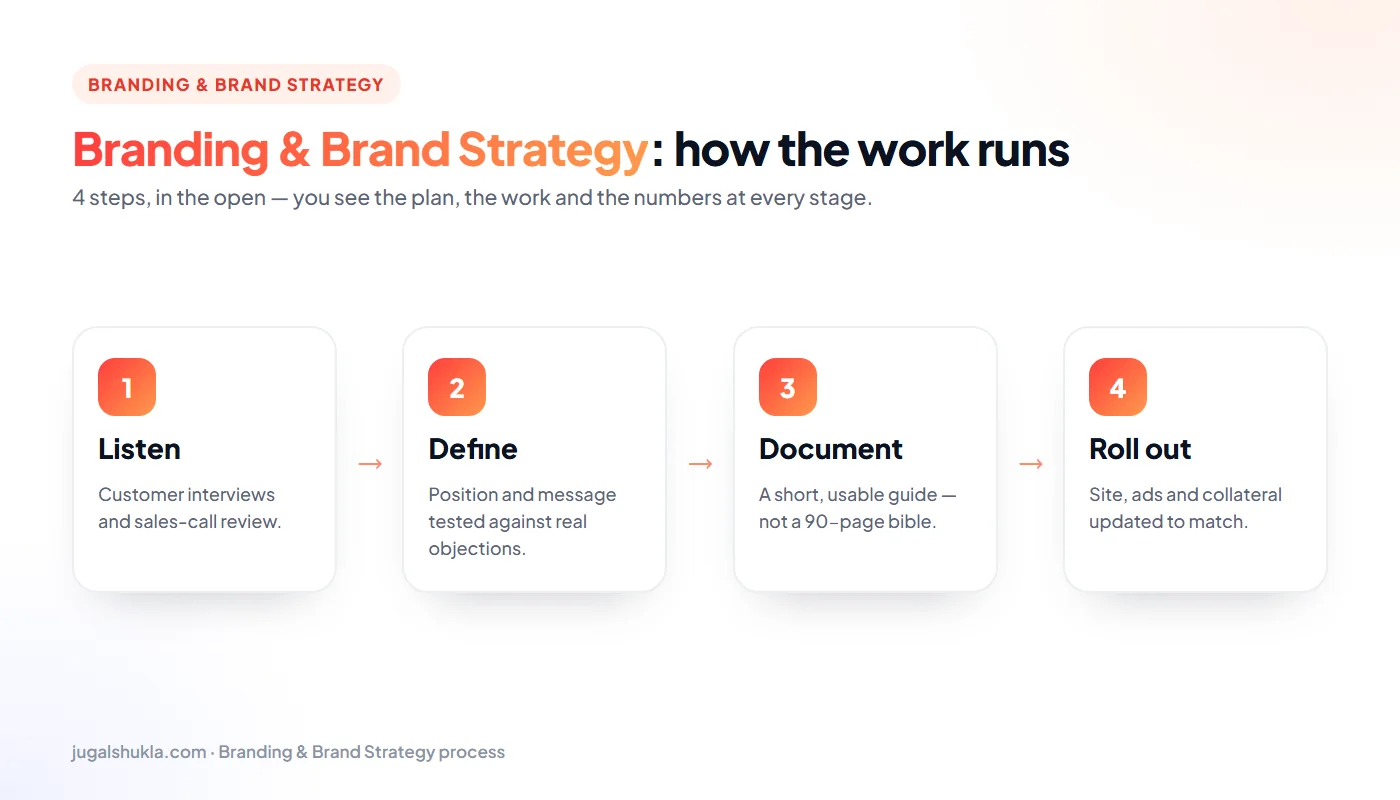
How I build your brand strategy
Branding process: Listen → Define → Document → Roll out
How a Branding & Brand Strategy engagement runs, step by step.
  1. Listen. Interviews with you, your team and customers; review of competitors, reviews and how people currently describe you.
  2. Define. Brand positioning, audience, promise, personality and key messages agreed in workshops.
  3. Document. Messaging, voice and visual direction turned into practical guidelines.
  4. Roll out. Website, profiles, templates and materials updated so every touchpoint feels like the same brand.
What branding costs

Branding projects range from a focused positioning and messaging sprint to a full identity with logo design and guidelines. I start with a Free Growth Call to understand where your brand stands and quote a fixed fee based on scope. For ongoing consistency on social media, the Social Presence Plan (₹6,999* a month) applies your brand every week.

Investing in brand strategy before redesigning a logo or website avoids the common and expensive mistake of changing visuals without changing what the brand actually says.

Timelines and results
  • Weeks 1–2: listening — interviews, customer research and competitor review.
  • Weeks 3–4: brand positioning and messaging defined.
  • Weeks 5–8: visual direction, guidelines and rollout plan.
  • Months 3–12: consistent application; branded search and direct enquiries grow.

Branding results build over time. Early signs include clearer sales conversations and better-converting marketing; longer-term signs are more people searching for you by name and less pressure on price.

Brand positioning: finding your difference

Brand positioning is the place your business occupies in customers' minds compared with alternatives. Strong positioning is specific, relevant and believable. Useful questions to find it:

  • Who are your best customers, and what do they have in common?
  • What do they value most — speed, expertise, price, care, convenience, prestige?
  • What do competitors all claim, and where is there space?
  • What can you prove — results, experience, certifications, guarantees?

The answer becomes a positioning statement: "For [audience] who [need], we are the [category] that [key difference], because [proof]." It guides every message, from your website headline to how your team answers the phone.

Messaging and brand voice

Messaging turns brand positioning into words customers understand. A messaging framework includes a one-sentence description of what you do, three to four key messages with supporting proof, and answers to the most common objections. Brand voice defines how you say it — for example warm but professional, confident but never arrogant, simple rather than technical. With both documented, everyone from your sales team to your social media manager describes the business consistently, and every piece of marketing reinforces the same impression.

Visual identity: logo, colours and type

Visual identity makes your brand recognisable at a glance. Effective identities are simple, distinctive and work everywhere — from a small social media icon to a shop sign. They include a logo with variations, a colour palette with clear usage rules, typography for headings and body text, image style and graphic elements. Visual choices should express the brand strategy: a premium consultancy and a budget retailer need very different looks, even in the same industry.

Branding for small and local businesses

Small businesses do not need big-company budgets for branding to work. Consistency matters more than spend: the same name, logo, colours, description and contact details on your shop front, Google Business Profile, website, WhatsApp profile, social media and invoices. Real photos of your team and premises build trust faster than polished stock images. Collecting and showing reviews strengthens your brand every week. Local businesses with a clear, consistent brand often win customers from larger competitors who look generic.

Branding mistakes
  • Starting with a logo before deciding what the brand stands for.
  • Trying to appeal to everyone, which makes the brand forgettable.
  • Copying the market leader instead of differentiating.
  • Inconsistency across channels and team members.
  • Rebranding too often, losing recognition built over years.
Questions to ask before a branding project
  • Will you research our customers and competitors before designing?
  • What will we receive — positioning, messaging, guidelines, visuals?
  • How will the new brand be rolled out across our channels?
  • Will our team be able to apply the guidelines without you?
  • How will we know the new brand strategy is working?
Brand architecture: one brand or many?

As businesses grow, they add products, services or locations — and must decide how these relate to the main brand. A single master brand concentrates trust and marketing investment; separate brands suit different audiences or price points; endorsed brands combine the two. The right brand architecture keeps customers clear about what you offer and avoids spreading budget thinly across names nobody remembers. It is an important part of brand strategy for any business planning expansion.

Bringing the brand to life across touchpoints

A brand is experienced at every point of contact: the website, Google Business Profile, social media, WhatsApp greeting, proposals, invoices, packaging, signage, uniforms and how the phone is answered. After defining brand positioning and identity, the rollout plan lists every touchpoint, prioritises those customers see most and updates them consistently. Templates for presentations, social posts and documents make it easy for the team to stay on-brand without design skills.

Employer branding and internal buy-in

Your team delivers the brand promise every day, so they need to understand and believe it. Sharing the brand strategy internally — why it was chosen, what it means for customers and how each role supports it — turns guidelines into behaviour. A strong brand also helps hiring: candidates choose employers whose purpose and culture are clear. Simple steps such as a careers page that reflects your values and team stories on social media strengthen both customer and employer branding.

Protecting your brand

Register your business name and logo as trademarks where appropriate, secure matching domain names and social media handles, and monitor for misuse or confusingly similar names. Keep contact details consistent everywhere so customers are not misled by outdated listings. Responding professionally to reviews — positive and negative — protects reputation, which is ultimately what branding is built to earn.

Brand and digital marketing

Strong branding makes every channel more effective. Ads with a clear, recognisable brand get better click-through rates. Websites with consistent messaging convert more visitors. Social media content with a distinctive voice and style is remembered and shared. Search improves too: as more people know your name, branded searches rise, and search engines and AI assistants find consistent information about your business across the web. Brand work therefore supports performance marketing rather than competing with it.

Refreshing an existing brand

Not every business needs a complete rebrand. A refresh keeps the recognition you have built — name, core colours, familiar elements — while modernising typography, layouts, photography and messaging. It is usually less risky, faster and more affordable, and suits brands whose strategy is sound but whose presentation feels dated. Testing new messaging in ads and landing pages before a full rollout reduces risk further.

Brand storytelling

Stories make brands memorable. Customers remember why a business was started, the problem it set out to solve, the moments it went the extra mile and the customers whose lives it changed far longer than they remember lists of features. A brand story should be true, specific and centred on the customer — your business as the guide that helps them succeed. Share it on your About page, in social media content, in sales presentations and in the way your team introduces the company. Consistent storytelling turns brand positioning from an internal document into something customers feel and repeat to others.

Brand consistency checklist

Once a year, review every touchpoint against your guidelines: website, profiles, listings, templates, signage and sales materials. Fix outdated logos, old descriptions and inconsistent contact details so your brand looks as reliable as the service behind it.
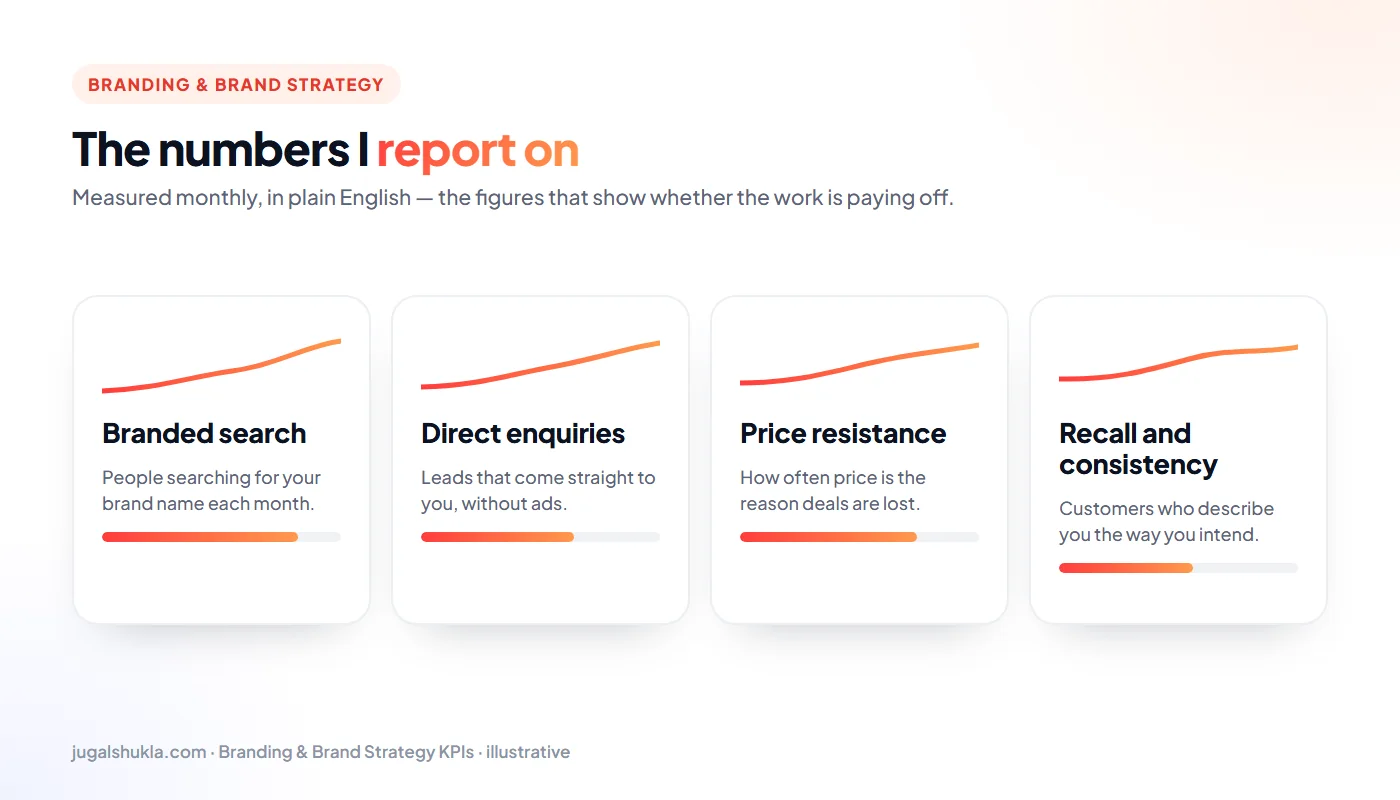
How to measure branding
Branding KPIs: Branded search, Direct enquiries, Price resistance, Recall and consistency
The numbers I report on every month (illustrative).
  • Branded search — monthly searches for your business name in Search Console.
  • Direct enquiries — leads arriving without paid ads.
  • Price resistance — how often price is the reason deals are lost.
  • Recall and consistency — whether customers describe you the way you intend.

Self-check: ask five recent customers to describe your business in one sentence. If the answers differ widely, brand positioning is the place to start.

FAQ

Branding questions, answered.

11 straight answers to what people ask me most about Branding & Brand Strategy. Still unsure? Send a quick message — I reply within 24 hours.

Still have a question?

Ask me directly — no bots, no sales team.

Do you design logos?

I direct identity work and partner with a designer for execution.

How long does it take?

Three to four weeks including customer interviews.

Is this useful for a small business?

Especially so — clarity is the cheapest growth lever you have.

What is the difference between branding and a logo?

A logo is one visual element. Branding is the full set of decisions — positioning, messaging, voice and visuals — that shape how people see your business.

What is brand positioning?

The specific place your business occupies in customers' minds compared with alternatives — who you serve and why you are the better choice.

Do small businesses need brand strategy?

Yes — a clear, consistent brand helps small businesses compete on trust rather than price.

How long does a branding project take?

Typically four to eight weeks, depending on research and visual scope.

Do you design logos?

I lead strategy and work with a designer for the logo and visual identity, so visuals follow the strategy.

Will rebranding hurt my SEO?

Not if the website changes and redirects are handled carefully. I plan rebrands to protect rankings.

What do brand guidelines include?

Positioning, messaging, voice, logo usage, colours, typography and image style — with examples.

How do I know if branding is working?

Branded searches, direct enquiries, conversion rates and less price pressure in sales conversations.

Next step

Want a hands-on partner, not a deck?

Tell me what you’re trying to grow. I’ll tell you honestly whether I’m the right person, and what I’d do first.

Send a quick brief

I reply within 24 hours.