Growth, Automation & Brand

AI-Powered Marketing

AI marketing that removes the grunt work — research, briefs, drafts and reporting automated, with a human editing every word.

Current offer
New

AI Visibility Sprint

Be the answer ChatGPT and Gemini give

₹7,999*/month
  • Baseline of how AI engines describe you
  • Schema, entity and profile clean-up
  • Answer-first rewrites of key pages
  • AI crawler and llms.txt check
  • Monthly AI share-of-voice tracking

*Prices are starting points for a typical scope — I confirm your exact quote after a short call. GST, third-party tools and ad spend are billed separately. T&C apply.

Sound familiar?

The problems I fix.

01

Your team pastes into ChatGPT and gets generic output.

02

Research and reporting eat days every month.

03

AI experiments never became a repeatable process.

What you get

Everything done, not just recommended.

Workflow audit

Which tasks are worth automating, and which aren’t.

Prompt library

Tested, versioned prompts for your voice and offer.

Content pipeline

Research → brief → draft → human edit, documented.

Competitor monitoring

Automated tracking of rival content and ads.

Reporting automation

Data pulled and summarised without manual work.

Team training

Live sessions plus a written playbook.

organic traffic for a B2B brand in 6 months
0 ×
more student inquiries via SEO + paid search
0 %
years of hands-on delivery
0 +
AI-Powered Marketing offers

Pick a starting point. Upgrade any time.

New

AI Visibility Sprint

Be the answer ChatGPT and Gemini give

₹7,999*/month
  • Baseline of how AI engines describe you
  • Schema, entity and profile clean-up
  • Answer-first rewrites of key pages
  • AI crawler and llms.txt check
  • Monthly AI share-of-voice tracking
Free

Free Growth Call

30 minutes. Your numbers. A clear next step.

Freefree call
  • Funnel and channel review
  • The two or three levers to pull first
  • Honest fit check — no hard sell
  • Written summary after the call

*Prices are starting points for a typical scope — I confirm your exact quote after a short call. GST, third-party tools and ad spend are billed separately. T&C apply.

How it works

A clear process, run in the open.

01

Map tasks

Time-log where the hours actually go.

02

Design

Build prompts and connect the tools.

03

Pilot

Run one full cycle with quality checks.

04

Embed

Train the team and hand over documentation.

Tools I use:ChatGPTClaude AIGeminiZapier / MakeMidjourney
The complete guide

AI marketing: the complete guide.

Everything worth knowing before you invest — what’s included, costs in India, timelines, mistakes to avoid and how to measure results. Open any chapter.

16 chaptersAbout 7 min readWritten by Jugal Kishore ShuklaUpdated October 2026
What AI marketing means in practice

AI marketing is the use of artificial intelligence tools — ChatGPT, Gemini, Claude, Copilot and specialised platforms — to research, create, analyse and automate marketing work faster, without lowering quality. It is not about replacing your team or publishing machine-written content at scale. It is about removing the slow, repetitive parts of marketing so people spend more time on strategy, creativity and customers.

As an AI marketing consultant, I help businesses adopt AI where it genuinely helps:

  • Research: summarising competitors, reviews, search results and customer feedback in minutes.
  • Content workflows: briefs, outlines, first drafts, repurposing and editing support — always with human review.
  • Ads: generating headline and creative variations for testing, and analysing search terms at scale.
  • Analytics: explaining reports, spotting anomalies and drafting monthly summaries.
  • Customer communication: first replies, FAQs and chat assistants with clear human handover.
  • Prompt engineering for marketing: reusable prompt libraries and templates your team can rely on.
  • Policies and training so AI is used safely, consistently and in your brand voice.
Who AI marketing is for
  • Small teams that need to produce more without hiring immediately.
  • Marketing teams spending hours on reports, briefs and repetitive content.
  • Founders who want to use ChatGPT and similar tools properly, not just occasionally.
  • Agencies and content teams looking to standardise AI workflows and quality.

AI marketing works best when you already know what good output looks like. If your positioning, audience and processes are unclear, AI will produce more of the same confusion faster — so strategy comes first.

How I introduce AI into your marketing
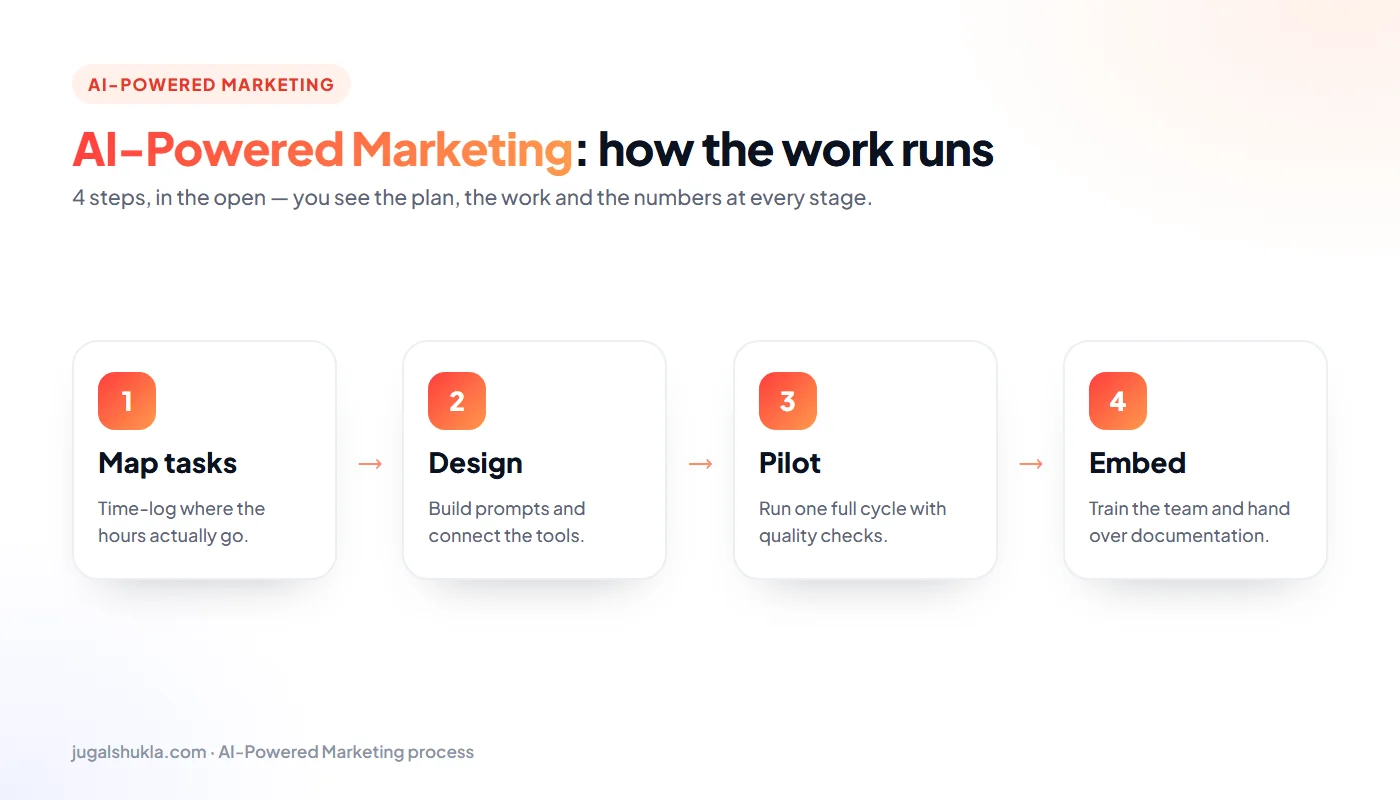
AI marketing process: Map tasks → Design → Pilot → Embed
How a AI-Powered Marketing engagement runs, step by step.
  1. Map tasks. List your recurring marketing tasks, the time each takes and the quality bar it needs.
  2. Design. For the most promising tasks, design workflows: which tool, what inputs, which prompts, what human checks.
  3. Pilot. Run the workflows on real work for two to four weeks; measure time saved and quality.
  4. Embed. Document the winners, train the team, build prompt libraries and set guidelines for safe use.

Starting with a small number of high-value workflows produces quick wins and builds confidence — far more effective than handing everyone a tool and hoping.

What AI marketing costs

Most AI tools cost between nothing and a few thousand rupees per user each month. The bigger investment is designing workflows and training people to use them well.

I start with a Free Growth Call to identify where AI could save the most time in your marketing, then quote a fixed fee for workflow design and training. If your goal is to be visible inside AI answers — ChatGPT, Gemini, Perplexity and Google AI Overviews — the AI Visibility Sprint (₹7,999* a month) focuses on that separately.

Timelines and results
  • Week 1: task mapping and priority workflows chosen.
  • Weeks 2–3: workflows and prompts designed and piloted.
  • Week 4: training, documentation and guidelines.
  • Months 2–3: review, refine and extend to further tasks.

Teams commonly save hours every week on research, drafting and reporting once workflows are embedded. The key measure is not how much AI is used, but how much faster good work gets done.

Prompt engineering for marketing

The quality of AI output depends heavily on the quality of the instruction. Prompt engineering for marketing means writing prompts that consistently produce useful, on-brand work. Effective marketing prompts include:

  • Role and context: who the AI is acting as, your business, audience and goal.
  • Source material: your notes, data, past content or customer quotes — AI is far better at shaping your knowledge than inventing its own.
  • Clear constraints: length, format, reading level, words to avoid, facts that must be included.
  • Examples: a sample of your brand voice or a past piece that worked.
  • A review step: asking the AI to check its draft against the brief before you edit.

I build prompt libraries for recurring tasks — ad variations, blog briefs, social captions, email sequences, report summaries — so every team member gets consistent results instead of starting from scratch.

AI for content without losing quality

Search engines and readers reward content that shows real experience and expertise. AI marketing content workflows should therefore keep humans in charge of the substance:

  • Humans provide the insight: experience, data, opinions, examples and case studies.
  • AI speeds up structure: outlines, first drafts, summaries and repurposing into other formats.
  • Humans edit and verify: facts checked, voice adjusted, claims supported.

Used this way, AI can halve content production time while improving consistency. Used as a shortcut to publish generic articles, it produces content that neither ranks nor persuades.

AI for ads and analytics

In paid advertising, AI helps generate many headline and creative variations for testing, group thousands of search terms by theme, and draft performance summaries. Google and Meta already use machine learning for bidding and targeting; an AI marketing consultant makes sure those systems receive accurate conversion data and strong creative inputs. In analytics, AI tools can explain unusual changes, answer questions about data in plain English and draft monthly reports — with a human checking conclusions before decisions are made.

Responsible AI: privacy, accuracy and brand safety
  • Privacy: never paste customer personal data or confidential information into tools that may use it for training; use business plans with appropriate data controls.
  • Accuracy: AI can state wrong facts confidently. Every claim, statistic and quote is verified before publishing.
  • Disclosure and honesty: no fake reviews, invented testimonials or misleading content.
  • Brand voice: guidelines and examples keep outputs sounding like you.
  • Copyright: avoid prompting for imitations of specific creators' work.

A short AI policy covering these points protects your brand and gives your team confidence to use the tools properly.

AI marketing mistakes
  • Publishing unedited AI content at scale.
  • Using AI without strategy, producing more noise rather than better marketing.
  • No prompt standards, so quality varies person to person.
  • Sharing sensitive data with consumer tools.
  • Measuring usage instead of outcomes.
  • Expecting AI to fix unclear positioning or weak offers.
Questions to ask an AI marketing consultant
  • Which of our tasks would benefit most from AI, and how much time could we save?
  • Which tools do you recommend, and what will they cost?
  • How will quality and accuracy be checked?
  • Will our team be trained and given documented workflows?
  • How will we handle privacy and confidential data?
High-value AI marketing workflows to start with

Most businesses get the quickest return from AI marketing by starting with a handful of workflows that are frequent, time-consuming and easy to check:

  • Competitor and review research: AI summarises competitor websites, ads and customer reviews into themes, gaps and opportunities in minutes instead of days.
  • Content briefs: from a keyword and your notes, AI drafts a structured brief with questions to answer, headings and internal links for a writer to follow.
  • Repurposing: one article or webinar becomes social posts, an email, a carousel outline and video scripts.
  • Ad variations: dozens of headline and description options, filtered by a human for accuracy and brand fit.
  • Reporting: monthly numbers turned into a plain-English summary with highlights and questions to investigate.
  • Customer FAQs: common questions from emails and chats grouped and answered consistently.

Each workflow gets a documented process, a tested prompt and a quality checklist. That is the practical difference between occasional AI use and AI marketing as a reliable part of how your team works.

Choosing AI tools for your team

The AI tool landscape changes every month, so I recommend a small, stable toolkit rather than chasing every new product. A general assistant — ChatGPT, Gemini, Claude or Microsoft Copilot — covers most writing, research and analysis tasks. Design tools such as Canva's AI features and video tools for captions and editing cover creative work. Automation platforms connect AI to your CRM, email and spreadsheets. As an AI marketing consultant, I choose tools based on your existing systems, data privacy needs and budget, and make sure business accounts with appropriate data settings are used for any company information.

Building an AI-ready marketing team

Successful AI marketing depends more on people than on tools. Teams adopt AI well when they understand what it is good at, have permission to experiment and share what works. I run practical workshops built around your real tasks: writing better prompts, checking outputs, combining AI with your own expertise and knowing when not to use it. A shared prompt library and a short internal guide keep quality consistent as the team grows. Prompt engineering for marketing becomes a team skill, not something only one enthusiastic person knows.

AI marketing for small businesses

Small businesses often benefit most from AI marketing because they have the least time. An owner can use AI to draft social posts from photos and notes, reply to common enquiries faster, write Google Business Profile updates, summarise customer reviews and prepare simple reports. The key is to keep the business owner's knowledge and voice at the centre and to check every output — AI marketing should make a small business sound more like itself, not more generic.

How to measure AI marketing
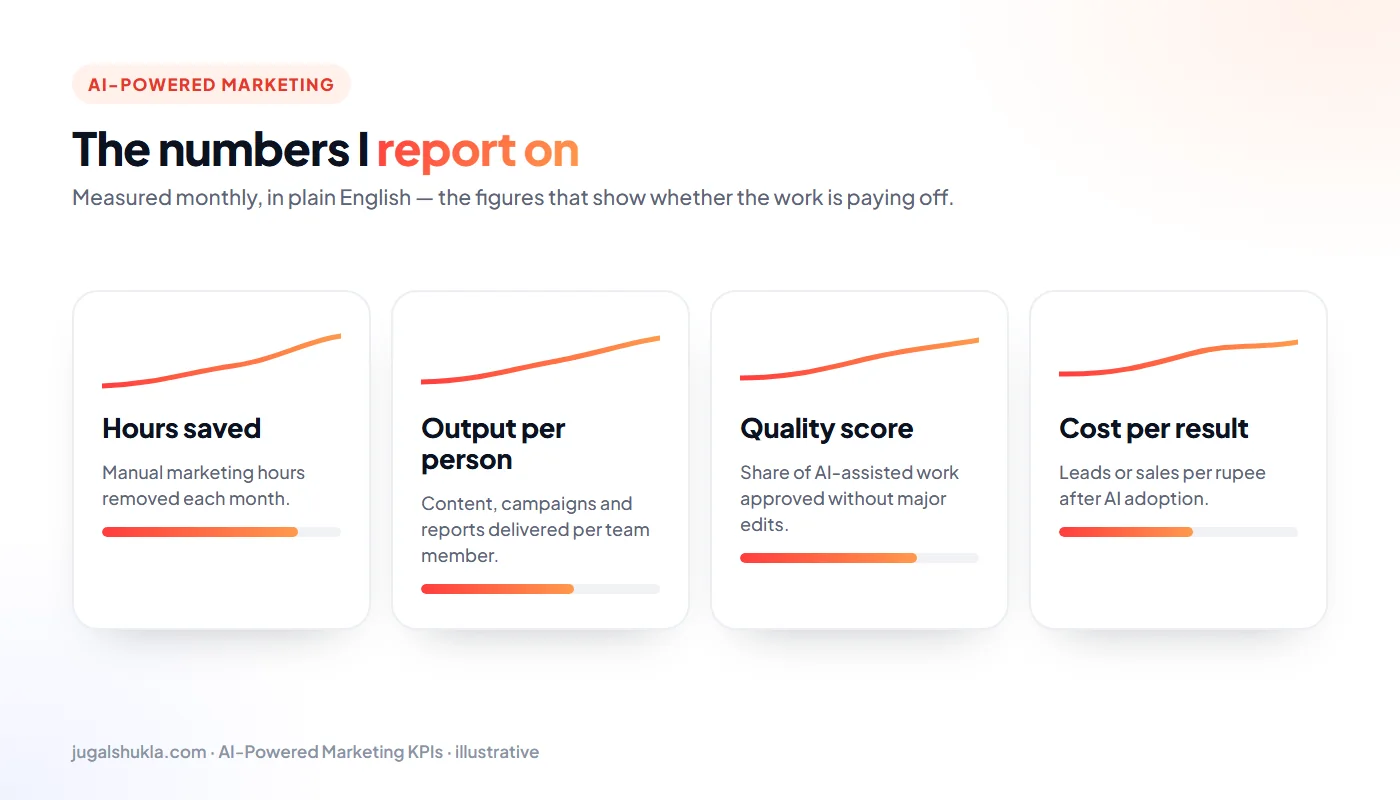
AI marketing KPIs: Hours saved, Output per person, Quality score, Cost per result
The numbers I report on every month (illustrative).
  • Hours saved on mapped tasks each month.
  • Output per person — content, campaigns and reports delivered.
  • Quality score — share of AI-assisted work approved without major edits.
  • Cost per result — leads or sales per rupee after AI adoption.

Self-check: list the five marketing tasks that take your team the most time each week. If any are research, drafting, reformatting or reporting, AI marketing can probably cut that time significantly.

FAQ

AI marketing questions, answered.

12 straight answers to what people ask me most about AI-Powered Marketing. Still unsure? Send a quick message — I reply within 24 hours.

Still have a question?

Ask me directly — no bots, no sales team.

Will AI content hurt my SEO?

Unedited output will. My workflows keep a human editor in every loop.

Is my data safe?

We use business-tier tools with training opt-out and clear data rules.

Do you certify this?

I hold Vanderbilt University's Prompt Engineering certification.

What's the realistic saving?

Around 50% of content production time, based on my own workflows.

What is AI marketing?

Using AI tools to research, create, analyse and automate marketing work faster — with people in charge of strategy and quality.

Will AI replace my marketing team?

No. It removes repetitive work so your team can focus on strategy, creativity and customers.

Which AI tools do you use?

ChatGPT, Gemini, Claude and Copilot for most tasks, plus specialised tools for design, video, analytics and automation where they fit.

Is AI-written content bad for SEO?

Unedited, generic AI content performs poorly. AI-assisted content built on real expertise and edited by people can perform very well.

What is prompt engineering for marketing?

Writing clear, reusable instructions that make AI tools produce consistent, on-brand marketing work.

Can you train my team to use AI?

Yes — workshops, documented workflows and prompt libraries tailored to your tasks.

Is it safe to use ChatGPT with company data?

Use business plans with proper data controls, and never paste personal customer data into consumer tools. I help set a simple policy.

How is AI marketing different from AI search optimisation?

AI marketing uses AI to do marketing work; AI search optimisation helps your brand appear in AI answers. The AI Visibility Sprint covers the second.

Next step

Want a hands-on partner, not a deck?

Tell me what you’re trying to grow. I’ll tell you honestly whether I’m the right person, and what I’d do first.

Send a quick brief

I reply within 24 hours.