Search & AI Visibility

Content Marketing

A content engine mapped to buying intent, produced with AI assistance and human editing, and repurposed across channels.

Current offer
Monthly

Content Engine

Four search-ready articles every month

₹7,999*/month
  • Topic and search-intent research
  • 4 articles a month, edited by me
  • Titles, meta descriptions and internal links
  • Image ideas and publishing support

*Prices are starting points for a typical scope — I confirm your exact quote after a short call. GST, third-party tools and ad spend are billed separately. T&C apply.

Sound familiar?

The problems I fix.

01

You publish blogs nobody reads.

02

Content ideas come from whoever had one that morning.

03

Every asset is used once and forgotten.

What you get

Everything done, not just recommended.

Content strategy

Audience, intent stages and topic clusters.

Editorial calendar

Three months of briefed, prioritised topics.

Brief templates

Structure, keywords, angles and internal links.

Production workflow

AI-assisted drafting with human editing gates.

Repurposing map

One pillar into social, email and video scripts.

Performance review

Traffic, rankings and assisted conversions per asset.

organic traffic for a B2B brand in 6 months
0 ×
more student inquiries via SEO + paid search
0 %
years of hands-on delivery
0 +
Content Marketing offers

Pick a starting point. Upgrade any time.

Monthly

Content Engine

Four search-ready articles every month

₹7,999*/month
  • Topic and search-intent research
  • 4 articles a month, edited by me
  • Titles, meta descriptions and internal links
  • Image ideas and publishing support

*Prices are starting points for a typical scope — I confirm your exact quote after a short call. GST, third-party tools and ad spend are billed separately. T&C apply.

How it works

A clear process, run in the open.

01

Research

Search demand, competitor gaps and sales objections.

02

Plan

Clusters and calendar agreed.

03

Produce

Briefs, drafts, edits and publishing.

04

Repurpose

Slice each pillar into channel-native pieces.

Tools I use:SEMrushAhrefsChatGPTClaude AISearch Console
The complete guide

Content marketing: the complete guide.

Everything worth knowing before you invest — what’s included, costs in India, timelines, mistakes to avoid and how to measure results. Open any chapter.

14 chaptersAbout 7 min readWritten by Jugal Kishore ShuklaUpdated October 2026
What content marketing includes

Content marketing is publishing useful material — articles, guides, comparisons, case studies, videos and posts — that attracts the right buyers, answers their questions and moves them towards an enquiry. Done properly, it is the engine behind SEO, AI search visibility and social media.

A complete content marketing strategy covers:

  • Audience and intent research: the questions buyers ask at each stage, taken from search data, sales calls and customer conversations.
  • Topic clusters: pillar pages and supporting articles mapped to search intent.
  • SEO content writing: briefs, drafts, editing, titles, meta descriptions and internal links.
  • Proof content: case studies, data and examples that build trust.
  • Repurposing: turning each article into LinkedIn posts, emails and short videos.
  • Measurement: rankings, traffic and the leads content influences.

The aim is not volume. It is a library of pages that keep bringing in qualified readers long after they are published.

Who content marketing is for

Content marketing works best when buyers research before deciding:

  • B2B services and products with longer sales cycles
  • High-consideration purchases — education, healthcare, finance, home improvement
  • Consultants and founders building authority in a niche
  • E-commerce brands that can answer buying questions and comparisons

If your customers buy on impulse or entirely on price, content plays a supporting role rather than a leading one. And if nobody in your business can spare 30 minutes a month to share expertise, content tends to drift towards generic — so I plan for that input from the start.
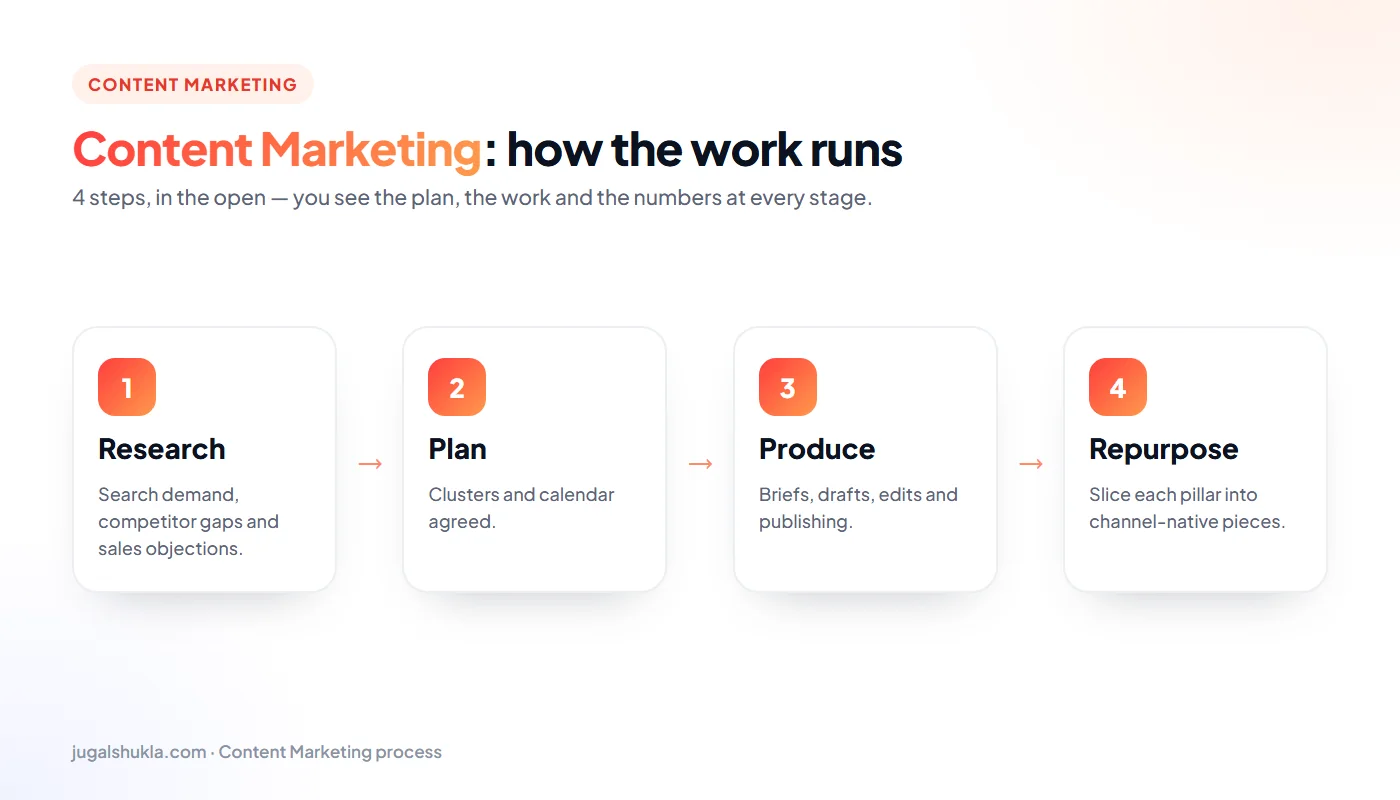
How I run content marketing
Content marketing process: Research → Plan → Produce → Repurpose
How a Content Marketing engagement runs, step by step.
  1. Research. Search intent, competitor gaps, sales objections and the questions customers actually ask.
  2. Plan. A content marketing strategy organised by topic clusters, with priorities based on business value, not just search volume.
  3. Produce. Detailed briefs, drafting with AI assistance for speed, and careful human editing for accuracy, voice and real examples. Every piece is optimised before publishing.
  4. Repurpose. Each article becomes LinkedIn posts, an email and short-form ideas, so one piece of work feeds several channels.

Using this process cut my own content production time by around half without lowering quality — the research and editing stay human; AI speeds up the middle.

What content marketing costs

Content costs in India range from ₹1–2 per word for generic writing to several thousand rupees per article for expert, researched pieces. The difference shows in the results: generic content rarely ranks or converts in competitive markets.

My Content Engine starts at ₹7,999* a month and includes topic and search-intent research, four articles a month edited by me, titles, meta descriptions and internal links, and image ideas plus publishing support.

What changes the price: article depth and length, technical subject matter, the need for original data or interviews, and whether design and video are included. Refreshing existing content is often cheaper and faster than writing new pieces — and is usually where I start.

Timelines and results
  • Months 1–2: refreshed existing articles regain rankings quickly; new pieces get indexed.
  • Months 3–6: clusters begin ranking for long-tail buyer questions; organic traffic to content grows.
  • Months 6–12: pillar pages compete for broader terms, and content starts showing up in the journeys of people who enquire.

Content is a compounding asset. The first months feel slow; after that, each new piece benefits from the authority the earlier ones built.

Content marketing mistakes to avoid
  • Publishing for the calendar, not the customer. "Two posts a week" with no strategy behind them.
  • Chasing volume keywords that attract readers who will never buy.
  • Generic AI content with no examples, opinions or expertise.
  • No internal links from articles to the service pages that convert.
  • Never updating old content while it slowly loses rankings.
  • Measuring only traffic instead of the leads content influences.
Repurposing: one article, a month of content

The most efficient content marketing teams do not create more — they reuse better. Every substantial article I produce is planned to feed several channels:

  • Three to five LinkedIn posts: one key insight per post, written for the feed rather than copied from the article.
  • A newsletter section: a short summary with a link back, so subscribers return to your website.
  • A carousel or infographic: the article's framework or checklist as a visual.
  • Short video scripts: 45-second explanations you or your team can record on a phone.
  • Sales enablement: a link your team can send when prospects ask the same question.
  • FAQ answers: added to the relevant service page with a link to the full piece.

Planned this way, one well-researched article supports SEO, social media, email and sales at the same time. It is also how a content marketing strategy stays affordable: the research and expertise are paid for once and used many times. SEO content writing becomes the core, and every other format points back to it — strengthening the page that ranks.

Building a content marketing strategy that sells

A content marketing strategy should read like a sales plan, not a publishing calendar. I build it in four layers:

1. Money pages first

The service, product or category pages that convert are strengthened before any blog post is written. Content should point to them, not compete with them.

2. Topic clusters around buying questions

Each money page gets a cluster of supporting pieces: costs, comparisons, how-to guides, checklists and FAQs — the questions buyers ask on the way to a decision.

3. Proof and trust

Case studies, examples, data and expert commentary that show you have done the work before. This is what turns a reader into an enquiry.

4. Distribution

Every piece is repurposed into LinkedIn posts, newsletter sections and short videos, and linked from relevant existing pages so it starts with authority.

Planned this way, content marketing stops being a cost centre and becomes a predictable source of qualified readers.

Your first 90 days of content marketing

Month 1 — research and quick wins

Intent research, competitor gaps, interviews with your team and an audit of existing content. The first refreshes go live — updating articles that already rank on page two is often the fastest win.

Month 2 — the first cluster

Four new pieces around one high-value topic, each linked to the relevant money page, plus repurposed LinkedIn posts and a newsletter section.

Month 3 — scale what works

Search Console data shows which pieces are gaining impressions; the next cluster doubles down on those themes. You receive the first report connecting content to traffic and assisted leads.

What makes SEO content writing rank

Search engines and AI assistants reward the same things readers do. Every piece I write or edit is checked against this list:

  • It answers the searcher's question in the first lines, then goes deeper.
  • It covers the topic completely, including the follow-up questions people ask next.
  • It includes first-hand expertise: examples, numbers, screenshots or opinions only someone experienced could give.
  • It is structured for scanning: clear headings, short paragraphs, lists and tables where useful.
  • It links to related pages and to the service that solves the reader's problem.
  • Every fact is verified, and the piece is updated when things change.

SEO content writing done this way does not read like it was written for search engines — which is exactly why it ranks.

Questions to ask before you hire a content marketing partner
  • Who researches the topics, and how? Look for search data plus real customer questions.
  • How do you use AI? AI-assisted is fine; unedited AI content is not.
  • Will you interview our team? Expertise has to come from somewhere.
  • How will content connect to our services? Internal linking and calls to action should be planned, not optional.
  • What will you measure? Traffic alone is not enough; ask about assisted conversions.
  • Do you refresh existing content? Often the best return comes from improving what you already have.

A good content marketing partner should be able to show you the plan for the next three months before you sign anything.

Repurposing: one idea, many formats

Good content marketing gets more value from every idea by turning it into several formats rather than starting from a blank page each time. One in-depth article can become:

  • A LinkedIn carousel summarising the key steps.
  • Three or four short posts, each built around one insight.
  • A short video or reel explaining the main point in under a minute.
  • An email to your list with a link back to the full article.
  • A downloadable checklist that captures leads.

Repurposing keeps your content marketing strategy consistent across channels and means each piece of SEO content writing supports social media and email too — without multiplying the effort.

Updating old content

Some of the best content marketing gains come from improving what you have already published. Articles that once ranked slip as competitors publish fresher answers. Review your top pages every six months: update statistics and examples, add sections that answer new questions, improve titles that get impressions but few clicks, and add internal links to newer services and articles. Refreshing a page that already has authority is often faster than ranking a new one.
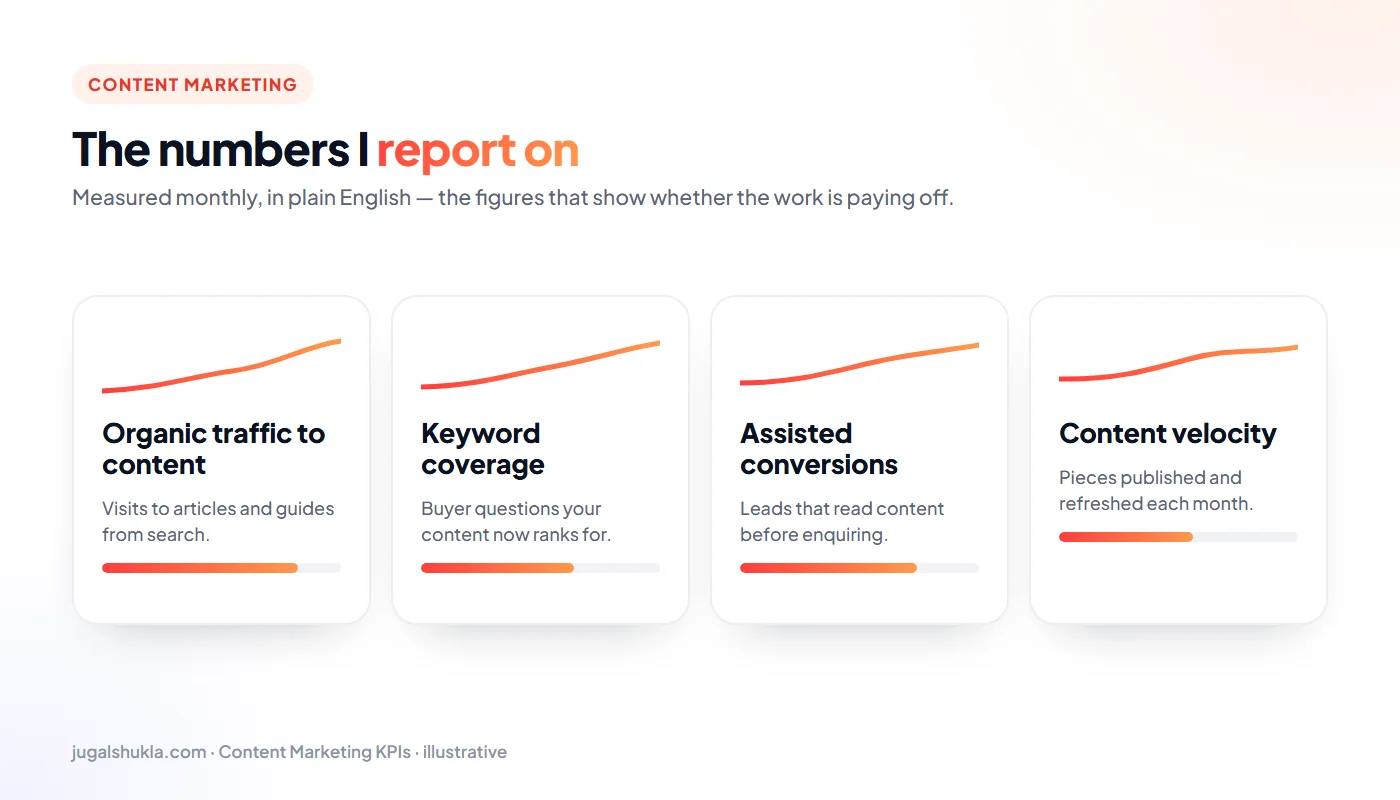
Measuring content marketing
Content marketing KPIs: Organic traffic to content, Keyword coverage, Assisted conversions, Content velocity
The numbers I report on every month (illustrative).

Every month I report on:

  • Organic traffic to content — visits from search to articles and guides.
  • Keyword coverage — buyer questions your content now ranks for.
  • Assisted conversions — leads that read content before enquiring, from GA4.
  • Velocity — pieces published and refreshed, so the engine keeps running.

Self-check: list the ten questions prospects ask most on sales calls. If your website does not answer at least half of them well, content marketing is likely your biggest untapped opportunity.

FAQ

Content marketing questions, answered.

11 straight answers to what people ask me most about Content Marketing. Still unsure? Send a quick message — I reply within 24 hours.

Still have a question?

Ask me directly — no bots, no sales team.

Do you write the content?

Yes, or I brief your writers and edit their output.

How much should we publish?

Fewer, deeper pieces beat weekly filler. Usually four to six strong assets a month.

Does this include design?

Simple graphics yes; heavy design through a partner.

How many articles do I need per month?

Quality beats volume. Four well-researched, well-linked articles a month usually outperform twenty thin ones — and refreshing existing content often comes first.

Do you use AI to write content?

AI helps with research and first drafts. Every piece is then edited by hand for accuracy, real examples and your voice — and checked against a quality list before publishing.

What is SEO content writing?

Writing that answers a specific search intent well, structured so search engines and AI assistants understand it — with the right headings, internal links and depth.

Can you write about technical or niche subjects?

Yes. I interview your experts for 20–30 minutes per topic so the content carries genuine expertise that generic writers cannot provide.

Will you publish the content on my website?

Yes — formatting, images, internal links, titles and meta descriptions are included.

How do you choose topics?

From search data, competitor gaps, your sales conversations and the questions customers ask before buying — prioritised by business value.

How long until content brings leads?

Usually three to six months for new content; refreshed articles can move within weeks.

Can content help with AI search visibility?

Yes. Answer-first, well-structured content is exactly what ChatGPT, Gemini and Google's AI Overviews cite.

Next step

Want a hands-on partner, not a deck?

Tell me what you’re trying to grow. I’ll tell you honestly whether I’m the right person, and what I’d do first.

Send a quick brief

I reply within 24 hours.