Free
Free Growth Call
30 minutes. Your numbers. A clear next step.
Freefree call
- Funnel and channel review
- The two or three levers to pull first
- Honest fit check — no hard sell
- Written summary after the call

A digital marketing strategy is a written decision about where your business will compete online, who it will win and how — with the budget, channels, messages and numbers that make it happen. It is the difference between doing "a bit of everything" and doing the few things that move revenue.
When I build a digital marketing strategy with a client, it covers:
The output is short and practical: a document your team can act on next week, not a hundred-slide deck that sits in a folder.
A digital marketing plan helps most when a business is at a turning point:
If you only need one channel fixed — say, Google Ads that are wasting money — you may not need a full strategy. A good marketing consultant will tell you that honestly rather than sell you a bigger project.
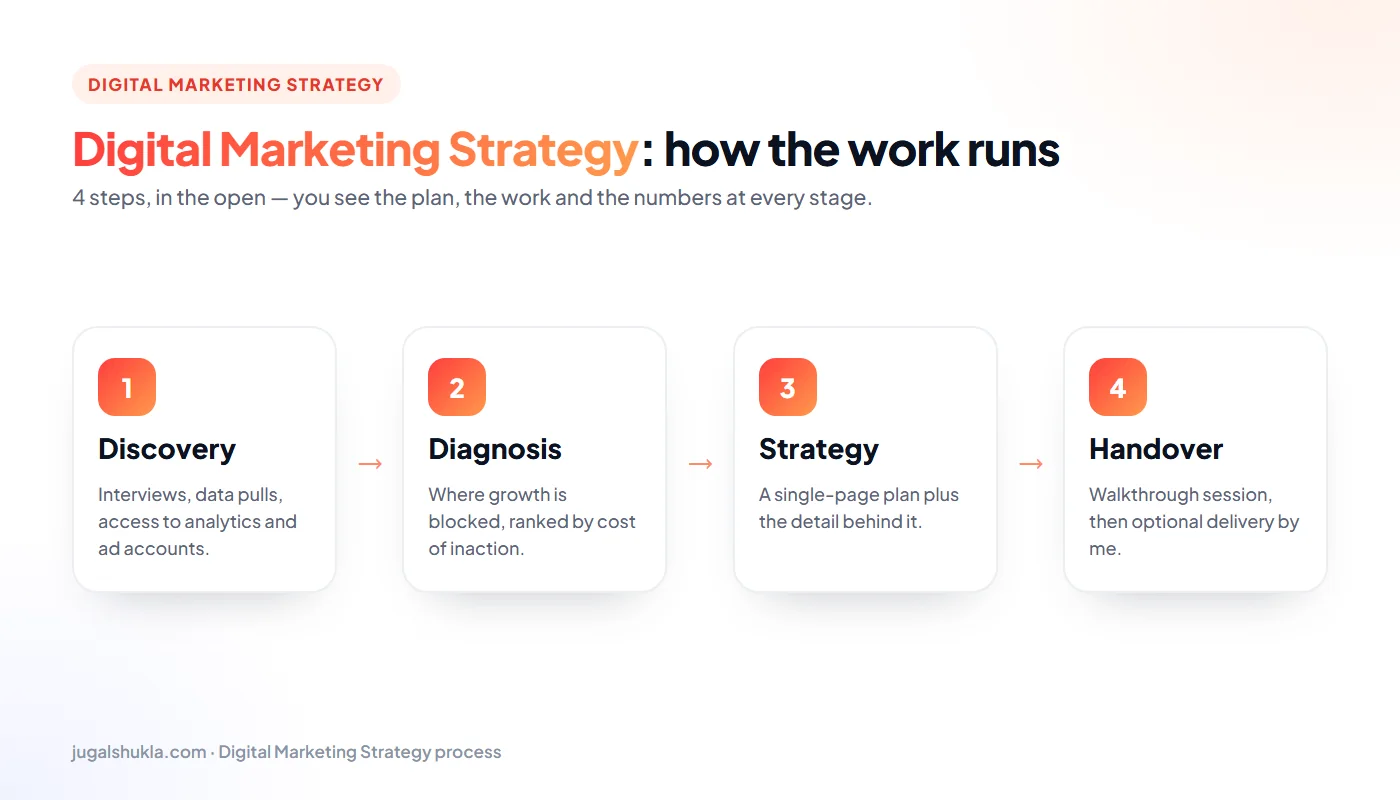
Every recommendation is tied to a number you can check later. If a channel cannot be measured, it gets a small test budget until it can.
Strategy work in India ranges from free "audits" that are really sales pitches to large consultancy projects. What matters is whether the advice is independent and specific to your business.
I start every engagement with a Free Growth Call: 30 minutes on your numbers, a review of your funnel and channels, the two or three levers worth pulling first and an honest fit check — followed by a written summary. If a full digital marketing strategy is the right next step, I quote a fixed fee based on scope, so there are no surprises.
Many clients then ask me to run part or all of the plan — SEO, ads, automation or analytics — on a monthly basis. That keeps strategy and execution in the same hands, so nothing gets lost between the plan and the work.
Results depend on the channels chosen. Paid search can produce leads within weeks; SEO usually compounds over six to twelve months. In one engagement, combining SEO with paid search produced 35% more student inquiries — the gain came from making the channels work together rather than from either one alone.
The most common strategic mistake is choosing channels by fashion rather than by where customers are and what they are ready to do. A simple framework helps:
Most small and mid-sized businesses should start with two channels done well, rather than six done badly. A digital marketing strategy decides which two — and when to add a third.
There is no universal percentage of revenue to spend on marketing. A better method starts from the numbers:
Your digital marketing plan should also reserve 10–20% of budget for testing new channels, offers and creatives. Without testing, a plan slowly stops working as markets change.
The best channel strategy fails if your message sounds like everyone else's. Positioning answers three questions in plain language:
I pull positioning from real customer language — reviews, sales calls and search queries — and test it in ads and landing pages, where results show quickly which message works.
Every digital marketing strategy needs a clear picture of the journey a customer takes. A simple funnel has four stages, and each needs different marketing:
Most businesses over-invest in one stage and neglect the others. A balanced digital marketing plan finds the weakest stage — often conversion or follow-up — and fixes it first, because improving the leakiest step lifts the results of everything above it.
Strategy becomes real when it turns into a short, dated plan. I write every digital marketing plan as a 90-day sprint with:
Ninety days is long enough to see results from most channels and short enough to change direction without wasting a year. At the end of each quarter, the plan is rolled forward: double down on what worked, fix or drop what did not, and add the next opportunity.
Once the digital marketing strategy is clear, the next question is who should do the work. Each option suits a different situation:
Many growing businesses combine them: a marketing consultant sets strategy, runs specialist channels and coaches an in-house executive who handles day-to-day content. The plan should state clearly who owns what, so nothing falls between the gaps.
AI tools can speed up research, drafting, reporting and analysis — but they work best inside a clear digital marketing strategy, not as a replacement for one. I use AI where it saves time without lowering quality: summarising customer feedback, drafting first versions of content for human editing, building reports and spotting patterns in data. Positioning, offers, budget decisions and anything customers read in its final form still need human judgement and real expertise.
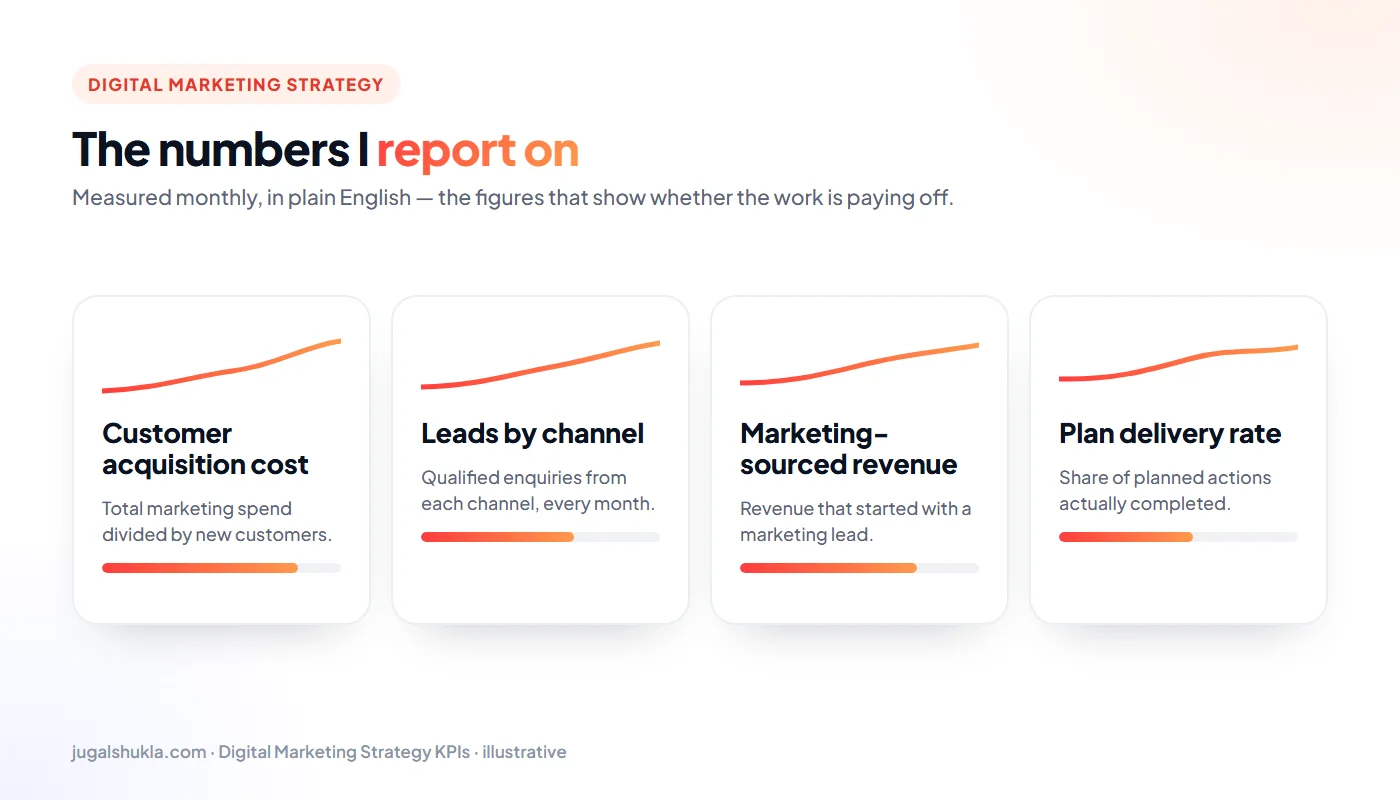
Self-check: can you name the channel that brought your last ten customers? If not, the first step of any digital marketing strategy is measurement.