Growth, Automation & Brand

Marketing Automation & CRM

Lead capture, scoring, nurture and handover wired end to end so no enquiry goes cold because someone forgot.

Current offer
Free

Free Growth Call

30 minutes. Your numbers. A clear next step.

Freefree call
  • Funnel and channel review
  • The two or three levers to pull first
  • Honest fit check — no hard sell
  • Written summary after the call

*Prices are starting points for a typical scope — I confirm your exact quote after a short call. GST, third-party tools and ad spend are billed separately. T&C apply.

Sound familiar?

The problems I fix.

01

Leads sit in an inbox for three days.

02

Sales says marketing leads are junk; marketing disagrees.

03

Your CRM is a spreadsheet with ambitions.

What you get

Everything done, not just recommended.

CRM configuration

Pipelines, stages, properties and required fields.

Lead capture

Forms, chat and ad lead objects piped in automatically.

Lead scoring

Behaviour and fit scoring agreed with sales.

Nurture sequences

Email and WhatsApp flows by segment and stage.

Internal alerts

Instant notifications with full lead context.

Ops dashboard

Speed to lead, stage conversion and pipeline value.

organic traffic for a B2B brand in 6 months
0 ×
more student inquiries via SEO + paid search
0 %
years of hands-on delivery
0 +
Marketing Automation & CRM offers

Pick a starting point. Upgrade any time.

Free

Free Growth Call

30 minutes. Your numbers. A clear next step.

Freefree call
  • Funnel and channel review
  • The two or three levers to pull first
  • Honest fit check — no hard sell
  • Written summary after the call

*Prices are starting points for a typical scope — I confirm your exact quote after a short call. GST, third-party tools and ad spend are billed separately. T&C apply.

How it works

A clear process, run in the open.

01

Map

Current journey from first touch to closed deal.

02

Configure

CRM, fields and integrations built out.

03

Automate

Flows, scoring and alerts switched on.

04

Train

Team walkthrough plus documentation.

Tools I use:HubSpotZapier / MakeGoogle Tag ManagerGA4Looker Studio
The complete guide

Marketing automation: the complete guide.

Everything worth knowing before you invest — what’s included, costs in India, timelines, mistakes to avoid and how to measure results. Open any chapter.

18 chaptersAbout 7 min readWritten by Jugal Kishore ShuklaUpdated October 2026
What marketing automation includes

Marketing automation uses software to do the repetitive work of capturing, following up and nurturing leads — so every enquiry gets a fast, consistent response and your team spends its time on conversations, not copy-pasting.

A typical marketing automation and CRM setup project covers:

  • CRM setup: pipelines, stages, fields and ownership rules that match how you actually sell.
  • Lead capture: website forms, ad lead forms, WhatsApp and calls flowing automatically into the CRM.
  • Instant alerts: the right person notified by WhatsApp or email the moment a lead arrives.
  • Follow-up sequences: emails and messages that go out on schedule until the lead responds.
  • Lead scoring: highlighting the hottest leads based on behaviour and fit.
  • Reporting: leads, conversion rates and revenue by source in one dashboard.
  • Training so your team uses the system every day.
Who marketing automation is for

Marketing automation pays off fastest for businesses that already generate leads but lose some of them through slow or inconsistent follow-up:

  • Service businesses handling enquiries from several channels.
  • Education providers managing admission enquiries and counselling.
  • B2B companies with longer sales cycles and multiple decision-makers.
  • Clinics, real estate and other high-value consumer services.

Warning signs you need it: leads sit in inboxes, nobody knows which enquiries were followed up, spreadsheets are out of date and the same question is answered manually fifty times a week.
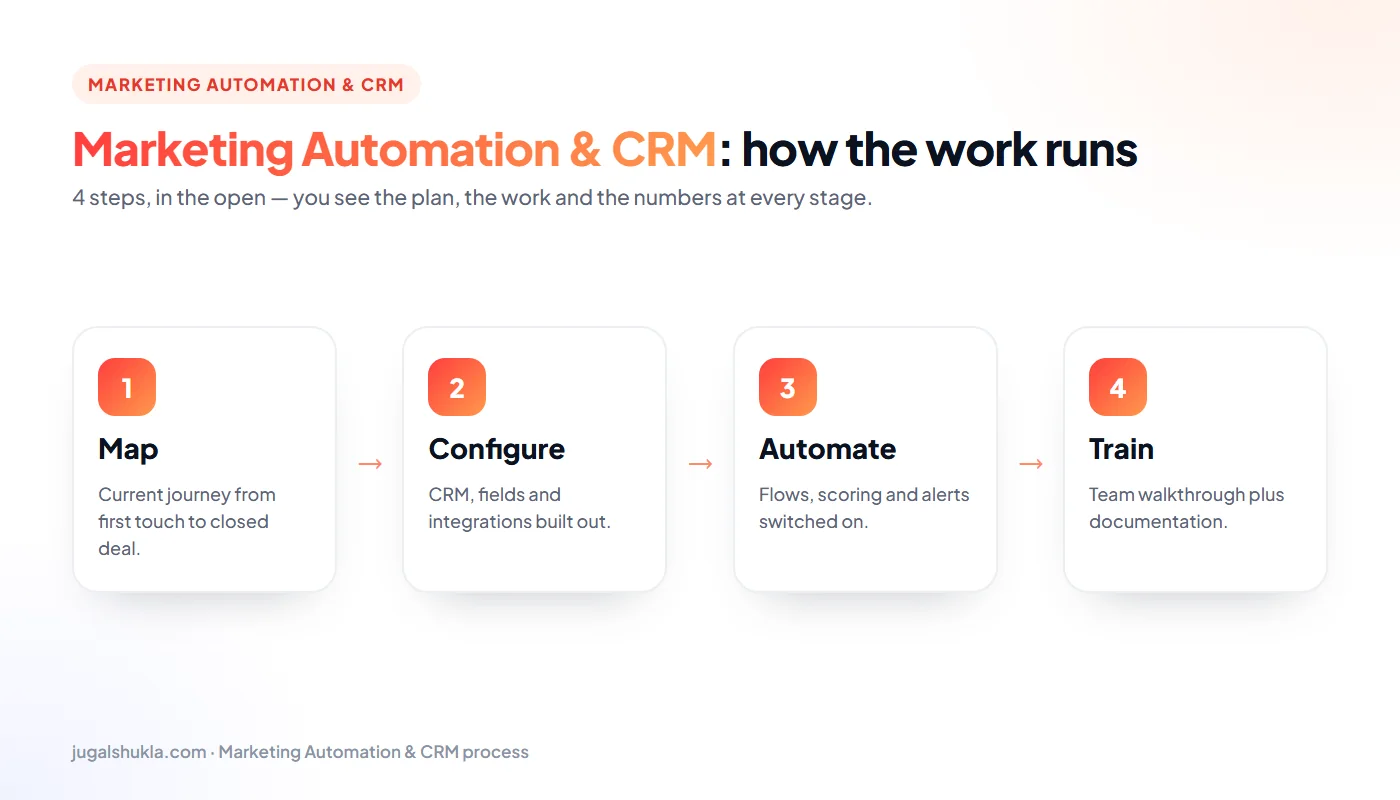
How I set up marketing automation
Marketing automation process: Map → Configure → Automate → Train
How a Marketing Automation & CRM engagement runs, step by step.
  1. Map. Your current lead journey drawn out step by step — every form, handover, delay and drop-off.
  2. Configure. CRM setup with pipelines, fields, users and permissions; integrations with your website, ad platforms and WhatsApp.
  3. Automate. Alerts, follow-up sequences, task reminders and scoring built and tested end to end.
  4. Train. Your team trained with short videos and a one-page guide, plus a review after 30 days.

Automation built on top of a messy process just makes the mess faster. That is why mapping comes first — often simplifying the process before any software is configured.

What marketing automation costs

Costs have two parts: software and setup. Many CRMs — HubSpot, Zoho and others — have free or low-cost starter plans that suit small teams, with paid tiers as you grow. Some businesses only need Google Sheets with automations to begin.

Setup is quoted per project after the Free Growth Call, where we review your current lead flow and decide what is worth automating first. As a marketing automation consultant, I recommend the simplest tool that does the job — the best system is the one your team will actually use.

Timelines and results
  • Week 1: mapping and tool choice.
  • Weeks 2–3: CRM setup, integrations and the first automations.
  • Week 4: testing, training and go-live.
  • Days 30–60: review and refinement based on real usage.

The first results are usually visible within weeks: faster responses, fewer lost leads and a pipeline everyone can see. Over months, nurturing sequences convert leads that would otherwise have gone cold.

Choosing a CRM

The right CRM depends on team size, sales process and budget more than on features lists:

  • Zoho CRM: affordable, flexible and popular with Indian businesses; good WhatsApp and telephony integrations.
  • HubSpot: excellent ease of use and marketing tools; the free tier is generous, paid tiers grow expensive.
  • Pipedrive: simple, visual pipeline management for sales-led teams.
  • Industry tools: specialised systems for education, real estate or clinics where workflows are very specific.

Whatever the tool, the CRM setup must reflect your real sales stages — and must be simple enough that the team keeps it updated.

WhatsApp automation for Indian businesses

In India, many customers prefer WhatsApp to email or phone calls. The WhatsApp Business Platform lets businesses automate parts of that conversation responsibly:

  • Instant acknowledgement of new enquiries with useful next steps.
  • Appointment confirmations and reminders that reduce no-shows.
  • Quick replies to frequent questions, handing over to a person when needed.
  • Opt-in follow-ups and updates using approved message templates.

Good marketing automation on WhatsApp feels helpful, not spammy: it respects opt-in, keeps messages relevant and always offers a way to reach a human.

Lead scoring and routing

Not every lead deserves the same attention at the same time. Lead scoring adds points for fit (location, budget, company size) and behaviour (pricing page visits, email clicks, repeat visits), so sales can prioritise. Routing rules then send each lead to the right person — by service, region or language — with a reminder if nobody responds. Together they make sure your best leads are never the ones that wait.

Marketing automation mistakes
  • Automating before mapping the process.
  • Too many fields and stages, so the CRM is abandoned.
  • Generic sequences that sound robotic.
  • No owner for reviewing and improving automations.
  • Ignoring consent on email and WhatsApp.
  • Buying an expensive tool for features nobody uses.
Questions to ask a marketing automation consultant
  • Which CRM would you recommend for our size and process, and why?
  • Will you connect our forms, ads and WhatsApp?
  • How will the team be trained?
  • Who owns the accounts and data?
  • What happens if something breaks after launch?
Automating the whole lead journey

The best marketing automation follows a lead from the first click to the closed deal, removing delays at every handover. A typical journey for a service business looks like this:

  1. Capture: a lead fills a website form, a Google or Meta lead form, or messages on WhatsApp. Every source flows into the CRM automatically, tagged with campaign and service.
  2. Acknowledge: within a minute, the lead receives a personal email or WhatsApp message confirming next steps and offering a booking link.
  3. Alert: the right salesperson is notified instantly, with the lead's details and source.
  4. Follow up: if the lead is not contacted within a set time, a reminder goes to the salesperson and their manager.
  5. Nurture: leads not ready to buy enter an email or WhatsApp sequence with useful content.
  6. Close and review: deal outcomes are recorded, so reports show which campaigns bring paying customers.

Each step is simple on its own; together they turn an unpredictable process into a reliable system. This end-to-end view is what a marketing automation consultant brings beyond simply configuring a tool.

CRM setup: designing pipelines your team will use

A CRM is only valuable if the data in it is complete and current. Good CRM setup keeps things simple:

  • Stages that match reality: for example New, Contacted, Qualified, Proposal, Won and Lost — with a clear definition of each.
  • Few required fields: only what is needed to qualify, follow up and report.
  • Lost reasons: a short list explaining why deals are lost, which feeds back into marketing.
  • Automatic data: source, campaign, service and date filled in by integrations, not typed by hand.
  • Mobile access so salespeople can update records between meetings.
  • Clear ownership: every lead has one owner and a next step with a date.

When the CRM is easier to use than the old spreadsheet, adoption takes care of itself.

Reporting that connects marketing to revenue

Marketing automation finally makes it possible to answer the question every owner asks: which marketing actually brings customers? With sources captured automatically and outcomes recorded in the CRM, a dashboard can show leads, qualified leads, deals and revenue by campaign, channel and service.

That visibility changes decisions. Budget moves to campaigns that produce customers rather than cheap leads, sales sees which sources close best, and follow-up gaps become obvious. I build these reports as part of the CRM setup, so they are useful from the first month.

Integrations: connecting your tools

Most businesses already use several tools — a website, ad platforms, WhatsApp, a calendar, accounting software. Marketing automation connects them so data flows without manual work. Native integrations cover many cases; tools such as Zapier, Make or Pabbly fill the gaps. I document every integration, so your team knows what connects to what and can troubleshoot or change it later without depending on me.

Data hygiene: keeping your CRM useful

Automation depends on clean data. Duplicate contacts, missing phone numbers, inconsistent service names and outdated stages break workflows and reports. Good CRM setup prevents most problems with required fields, drop-down lists instead of free text and automatic duplicate checks. A short monthly clean-up — merging duplicates, closing stale deals and fixing missing sources — keeps marketing automation accurate as volumes grow.

Starting small and expanding

The best marketing automation projects start with one high-impact workflow — usually instant lead capture, alerts and acknowledgement — and expand once the team trusts the system. Each new automation is added only when the previous one works reliably, so complexity never outruns adoption.

Marketing automation for education and admissions

Education providers handle large volumes of enquiries in short seasons, and every unanswered enquiry can be a lost admission. Marketing automation helps counselling teams respond instantly, assign leads by course or city, schedule calls and campus visits, send reminders before deadlines and nurture parents and students with useful information over weeks. Dashboards show enquiries, applications and admissions by source, so marketing budgets follow the campaigns that fill seats. A good CRM setup for admissions often pays for itself within a single season.
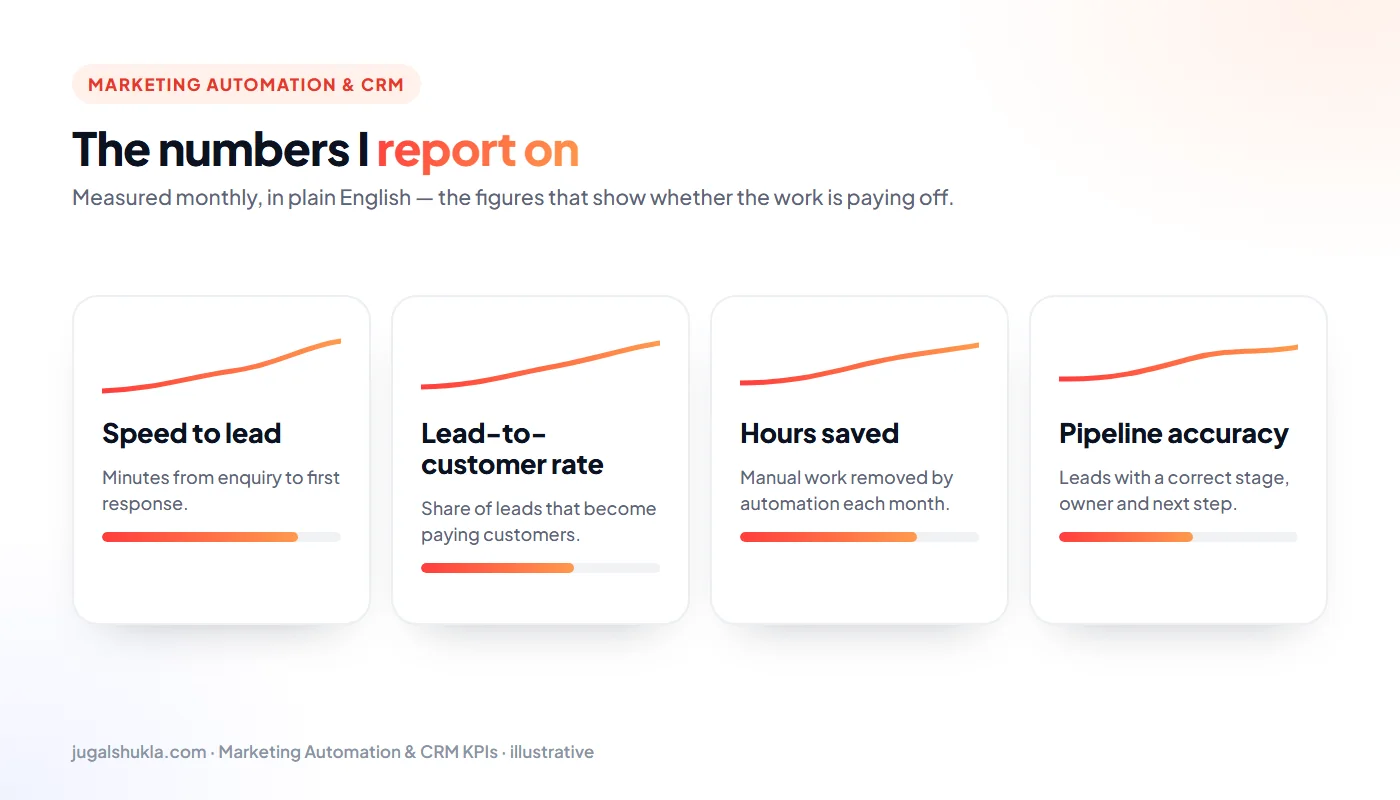
How to measure marketing automation
Marketing automation KPIs: Speed to lead, Lead-to-customer rate, Hours saved, Pipeline accuracy
The numbers I report on every month (illustrative).
  • Speed to lead — median minutes from enquiry to first response.
  • Lead-to-customer rate — before and after automation.
  • Hours saved — manual tasks removed each month.
  • Pipeline accuracy — leads with a correct stage, owner and next step.

Self-check: pick five leads from last month. Can you see when each arrived, who followed up, when and what happened next? If not, CRM setup is the place to start.

FAQ

Marketing automation questions, answered.

11 straight answers to what people ask me most about Marketing Automation & CRM. Still unsure? Send a quick message — I reply within 24 hours.

Still have a question?

Ask me directly — no bots, no sales team.

Which CRMs do you work with?

HubSpot most often; Zoho, Pipedrive and custom stacks via Zapier or Make.

Can you migrate our existing data?

Yes, including deduplication and property mapping.

Do you set up WhatsApp flows?

Yes, through approved business API providers.

What is marketing automation?

Software that captures leads, alerts your team and sends follow-ups automatically, so every enquiry gets a fast, consistent response.

Which CRM do you recommend?

It depends on your process and budget — often Zoho or HubSpot for small and mid-sized teams. I recommend the simplest tool your team will use.

Can you automate WhatsApp follow-ups?

Yes, through the WhatsApp Business Platform with opt-in and approved templates.

How long does CRM setup take?

Usually three to four weeks from mapping to go-live, including training.

Do I need a big team to use marketing automation?

No. Small teams often benefit most because automation does the repetitive work for them.

Can you connect Facebook and Google lead forms to my CRM?

Yes — leads from ads, website forms and WhatsApp can all flow into one place.

Will automation make my communication feel robotic?

Not if it is written well. Sequences sound personal and always hand over to a person when needed.

What does a marketing automation consultant cost?

Setup is quoted per project after a free growth call; software costs depend on the tool and team size.

Next step

Want a hands-on partner, not a deck?

Tell me what you’re trying to grow. I’ll tell you honestly whether I’m the right person, and what I’d do first.

Send a quick brief

I reply within 24 hours.