Paid Ads & Performance

PPC Advertising

Full-funnel paid campaigns across search, display and video, managed to CPA and pipeline rather than impressions.

Current offer
Paid search

Google Ads Lead Plan

Turn Google searches into enquiries

₹4,999*/month management
  • Account and competitor audit
  • Campaigns, keywords and ad copy
  • Call, form and WhatsApp tracking
  • Weekly bid and negative-keyword work
  • Monthly cost-per-lead report

*Prices are starting points for a typical scope — I confirm your exact quote after a short call. GST, third-party tools and ad spend are billed separately. T&C apply.

Sound familiar?

The problems I fix.

01

Cost per lead keeps drifting upward.

02

Leads arrive but sales calls them unqualified.

03

Reporting stops at clicks and CTR.

What you get

Everything done, not just recommended.

Campaign architecture

Prospecting, retargeting and brand defence separated.

Creative pipeline

A steady stream of ad variants, not one set left running.

Audience strategy

First-party lists, lookalikes and intent signals.

Lead quality loop

CRM feedback wired back into optimisation.

Budget pacing

Weekly pacing so nothing over- or under-spends.

Dashboard

Spend, CPL, qualified rate and CAC in one place.

organic traffic for a B2B brand in 6 months
0 ×
more student inquiries via SEO + paid search
0 %
years of hands-on delivery
0 +
PPC Advertising offers

Pick a starting point. Upgrade any time.

Paid search

Google Ads Lead Plan

Turn Google searches into enquiries

₹4,999*/month management
  • Account and competitor audit
  • Campaigns, keywords and ad copy
  • Call, form and WhatsApp tracking
  • Weekly bid and negative-keyword work
  • Monthly cost-per-lead report

*Prices are starting points for a typical scope — I confirm your exact quote after a short call. GST, third-party tools and ad spend are billed separately. T&C apply.

How it works

A clear process, run in the open.

01

Set the target

Agree an allowable CPA before spending anything.

02

Build

Campaigns, tracking and creative shipped together.

03

Test

Structured creative and audience tests every fortnight.

04

Scale

Push spend where the unit economics hold.

Tools I use:Google AdsMeta Business ManagerGA4Looker StudioGoogle Tag Manager
The complete guide

PPC advertising: the complete guide.

Everything worth knowing before you invest — what’s included, costs in India, timelines, mistakes to avoid and how to measure results. Open any chapter.

18 chaptersAbout 7 min readWritten by Jugal Kishore ShuklaUpdated October 2026
What PPC advertising management covers

PPC advertising — pay per click — is any advertising where you pay when someone clicks: Google Search, Shopping and YouTube, Microsoft Ads, Meta, LinkedIn and others. PPC management is the discipline of deciding where your budget goes, building the campaigns and continually improving them so every rupee earns more.

My PPC management service includes:

  • Channel selection: which platforms suit your buyers and budget — not all of them at once.
  • Targets: a clear cost-per-acquisition or ROAS target linked to your margins.
  • Campaign builds for search, shopping, social and remarketing.
  • Tracking through Tag Manager, GA4 and offline conversion imports.
  • Testing of ads, offers, audiences and landing pages.
  • Budget management across channels, moving money weekly to what works.
  • One report showing every channel in the same currency: leads, sales and cost.

Unlike a pay per click agency that runs channels in silos, I manage them as one budget aimed at one target.

Who needs PPC management
  • Businesses spending ₹30,000 a month or more across two or more ad platforms.
  • E-commerce stores running Shopping, Performance Max and Meta together.
  • Lead-generation businesses that need predictable enquiry volume.
  • Companies whose current ad spend grows while results stay flat.

If you are just starting with paid ads, begin with one channel — usually Google Search — before spreading budget thin. PPC advertising rewards focus.

How I run PPC advertising
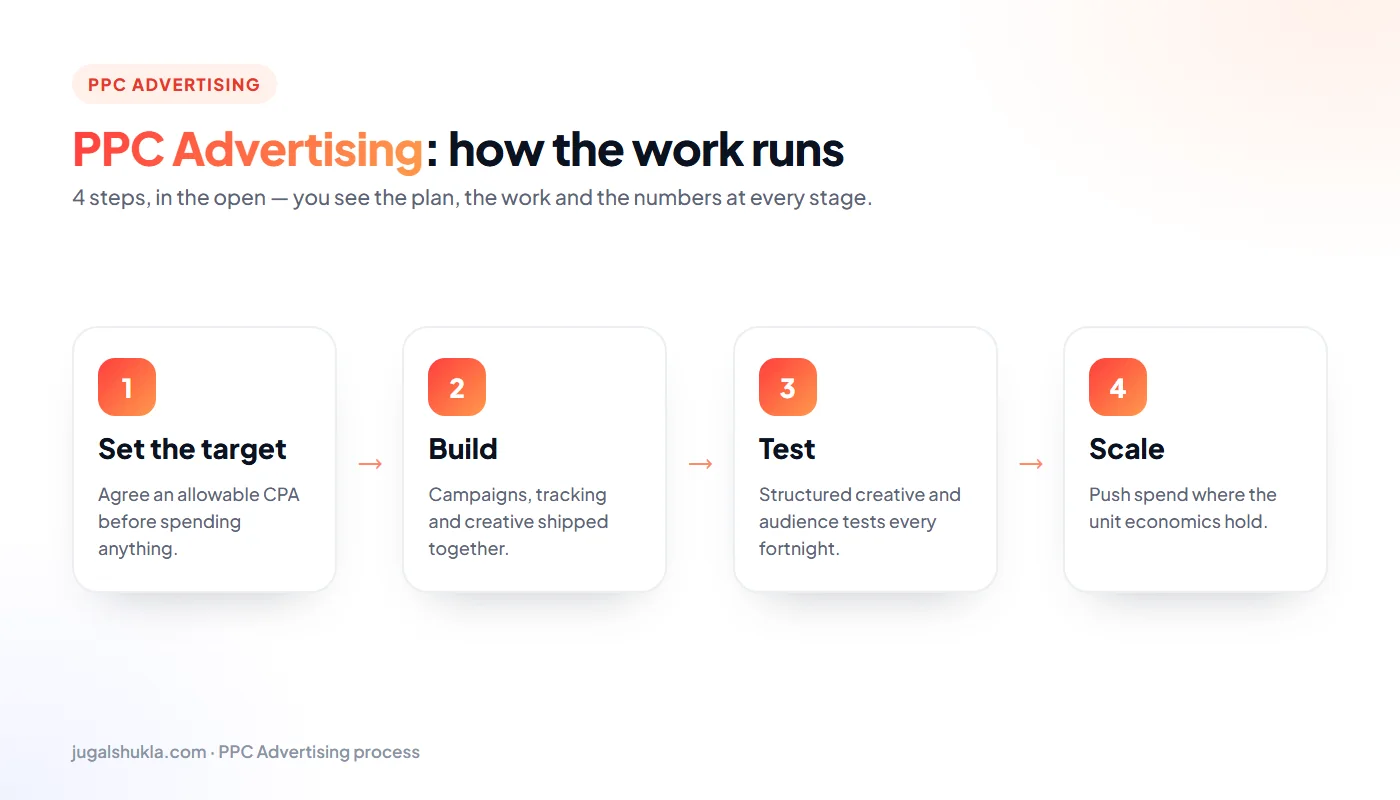
PPC advertising process: Set the target → Build → Test → Scale
How a PPC Advertising engagement runs, step by step.
  1. Set the target. We agree an affordable cost per lead or ROAS based on your margins and close rates.
  2. Build. Campaigns on the right channels with tracking verified, landing pages matched and negatives in place from day one.
  3. Test. Structured tests of ads, audiences, bidding strategies and offers, one variable at a time.
  4. Scale. Budget moved to the channels and campaigns beating target; new channels added only when existing ones are optimised.
What PPC advertising costs

PPC costs have two parts. Ad spend is set by your goals and market — many Indian SMBs begin between ₹20,000 and ₹1,00,000 a month across platforms. Management fees vary from a flat monthly fee to a percentage of spend.

For Google-led search campaigns, my Google Ads Lead Plan starts at ₹4,999* a month; for businesses running Google, Meta and LinkedIn together, the Full-Funnel Leads plan starts at ₹9,999* a month. Both include tracking, weekly optimisation and a monthly report.

Whatever you pay, insist on owning every ad account and on seeing spend, leads and sales in one place.

Timelines and results

PPC advertising produces data from day one, which is its great advantage. Typical progress:

  • Weeks 1–2: launch, tracking checks and early waste removed.
  • Weeks 3–8: tests reveal winning keywords, audiences and creatives; cost per acquisition starts to fall.
  • Months 3–6: stable performance against target, then controlled scaling.
Your first 90 days of PPC management

Month 1

Audit of existing accounts, targets agreed, tracking repaired, quick wins applied — often by cutting spend that clearly does not convert.

Month 2

Rebuilt campaigns on the strongest channels, a testing plan and the first budget reallocation between platforms.

Month 3

Optimised bidding, remarketing across channels and a single performance dashboard you can check any day.

PPC mistakes that drain budgets
  • Running every channel at once with too little budget for any of them to learn.
  • Different conversion definitions on each platform, so results cannot be compared.
  • No negative keywords or exclusions.
  • Letting platforms "self-report" success instead of checking against GA4 and the CRM.
  • Ignoring landing pages, so better ads simply send more people to a page that does not convert.
  • Never pausing anything — campaigns accumulate and nobody knows which earn their keep.
Questions to ask a pay per click agency or consultant
  • What target will you optimise to, and how did you calculate it?
  • Will I own every ad account?
  • How will results be measured consistently across platforms?
  • How often will budgets be reviewed and reallocated?
  • Who works on my account each week?
  • What happens to my data if we part ways?
How PPC works with SEO, CRO and analytics
  • SEO: PPC search-term data shows which keywords convert, guiding SEO priorities.
  • CRO: improving landing-page conversion lowers cost per acquisition on every channel at once.
  • Analytics: clean GA4 and offline conversion data make smart bidding work.
  • Email and automation: nurture turns paid leads that are not ready yet into customers later.
Search, social or shopping: where to put your PPC budget

Every platform in PPC advertising captures a different kind of buyer. Splitting budget well is the first job of PPC management.

ChannelBest forWatch out for
Google SearchPeople already searching for your serviceBroad keywords and missing negatives
Shopping / Performance MaxE-commerce with a clean product feedLimited visibility into where spend goes
Meta (Facebook & Instagram)Creating demand, local offers, D2CLow-intent leads without qualification
LinkedInHigh-value B2B audiencesHigh cost per click
YouTubeAwareness and remarketingMeasuring only last-click results
Microsoft AdsExtra search volume at lower costSmaller audience in India

A typical starting split for a service business is mostly Google Search, a smaller Meta budget for remarketing and demand creation, and LinkedIn only where deal values justify it. From there, budget follows cost per acquisition — every week, not every quarter.

Bidding strategies and when to trust automation

Modern PPC advertising runs largely on automated bidding — Google's Target CPA and Target ROAS, Meta's lowest-cost and cost-cap bidding, LinkedIn's maximum delivery and cost caps. Automation is powerful, but it needs three things to work:

  • Accurate conversion tracking that counts only genuine leads and sales.
  • Enough conversion volume — typically at least 15–30 conversions a month per campaign.
  • Stable settings — frequent changes reset the learning period.

Where volume is low, I keep campaigns more manual and consolidated until there is enough data. Where tracking is strong, automated bidding consistently beats manual control. Knowing which situation applies is one of the main reasons to hire an experienced PPC management partner rather than relying on platform defaults.

Feeding real sales data back to the ad platforms

Ad platforms optimise towards whatever you tell them is a success. If the only signal is "form submitted", they find people who fill in forms — not necessarily people who buy. Offline conversion imports fix that.

  1. Capture the click ID (GCLID, FBCLID) with every lead in your CRM or sheet.
  2. Mark outcomes: qualified, proposal sent, won — with deal value where possible.
  3. Send outcomes back to Google Ads and Meta automatically or weekly.
  4. Optimise to the deeper goal: qualified leads or revenue rather than raw form fills.

This single change often improves lead quality more than any targeting or creative tweak. It is a standard part of how I run PPC advertising for lead-generation businesses.

Remarketing across channels

Most visitors leave without enquiring. Remarketing brings them back with a relevant message, and across channels it is usually the cheapest source of conversions in any PPC programme.

  • Google: search remarketing raises bids for past visitors who search again; display and YouTube remind them.
  • Meta: testimonials and offers for people who visited key pages or watched your videos.
  • LinkedIn: case studies and invitations for B2B visitors from target companies.
  • Email and WhatsApp: for leads already captured, nurture often works better than more ads.

Frequency caps and sensible exclusions keep remarketing helpful rather than intrusive — nobody wants to be followed by the same banner for months.

Landing pages for PPC advertising

The landing page decides whether a paid click becomes a lead, so PPC management without landing-page work leaves most of the opportunity untouched. A strong PPC landing page:

  • Matches the ad: the headline repeats the promise that earned the click.
  • Loads fast on mobile — most paid clicks in India come from phones.
  • Has one goal: a call, a form or a WhatsApp chat, without distracting navigation.
  • Shows proof: reviews, client logos, results and guarantees near the call to action.
  • Keeps forms short: only the fields sales genuinely needs.

Improving conversion rate from 3% to 6% halves your cost per lead at the same budget — the most powerful lever in PPC advertising, and one that any good pay per click agency should work on with you.

Seasonality and budget planning

Demand for most services rises and falls through the year — admissions, festivals, financial year end, weather and wedding seasons all move click costs and conversion rates. Smart PPC management plans for this:

  • Budgets increased ahead of peak demand, not after competitors have already captured it.
  • Offers and ad copy refreshed for each season.
  • Seasonality adjustments to smart bidding for short promotions.
  • Quieter months used for testing new keywords and landing pages.
Reporting that shows what PPC really earns

A useful PPC report fits on one page: spend, leads, cost per lead, lead quality from your sales team and what changed this month. Behind it sit the detailed numbers — campaigns, keywords, search terms and devices — for anyone who wants to dig deeper. Clear reporting keeps PPC management accountable.

Brand campaigns in PPC advertising

Bidding on your own brand name is usually the cheapest click in any PPC account. It protects you from competitors who bid on your name, lets you control the message searchers see and captures people who already intend to contact you. Keep brand campaigns separate so they do not inflate the performance of other campaigns.

How to measure PPC advertising
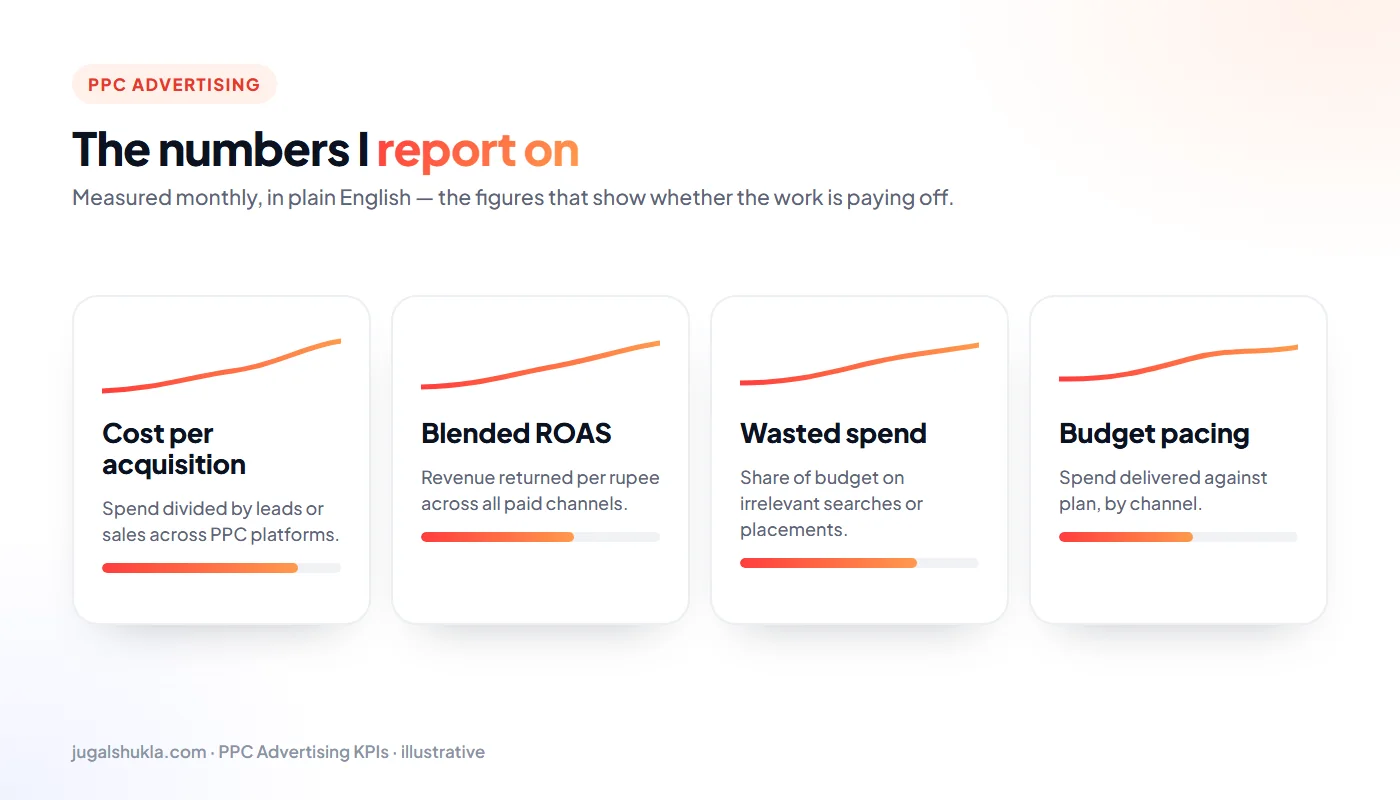
PPC advertising KPIs: Cost per acquisition, Blended ROAS, Wasted spend, Budget pacing
The numbers I report on every month (illustrative).
  • Cost per acquisition — across all paid channels, using one definition of a lead or sale.
  • Blended ROAS — total revenue against total ad spend.
  • Wasted spend — irrelevant searches, placements and audiences, trending down every month.
  • Budget pacing — spend against plan so there are no month-end surprises.

Self-check: can you see last month's leads and spend for every ad platform in one table? If not, PPC management should start with measurement.

FAQ

PPC advertising questions, answered.

11 straight answers to what people ask me most about PPC Advertising. Still unsure? Send a quick message — I reply within 24 hours.

Still have a question?

Ask me directly — no bots, no sales team.

Which networks do you run?

Google, Meta, LinkedIn and YouTube, chosen by where your buyers actually are.

How is your fee structured?

Flat monthly retainer, not a percentage of spend — no incentive to inflate budgets.

Do you produce creative?

Copy and static creative yes; video through a partner.

What is the difference between PPC and SEM?

SEM usually means paid search engine advertising. PPC is broader — any pay-per-click advertising, including social platforms like Meta and LinkedIn.

Which PPC platform should I start with?

Usually Google Search, because it captures people already looking for what you sell. Add others once it is profitable.

Do you charge a percentage of ad spend?

No — a flat monthly fee, so my advice on budget is never influenced by how much you spend.

How much budget do I need for PPC advertising?

Many small businesses start with ₹20,000–₹30,000 a month on one platform. Running several platforms well needs more.

Can you manage campaigns in other countries?

Yes — I manage campaigns for clients in India and abroad, with targeting, currency and time zones set accordingly.

How do you prevent click fraud?

By excluding irrelevant placements, monitoring unusual click patterns and focusing on search and verified audiences.

Will you work with my existing landing pages?

Yes, and I will suggest specific improvements — or build a landing page that converts better.

How often will I get reports?

A monthly report in plain English, plus a live dashboard you can check any time.

Next step

Want a hands-on partner, not a deck?

Tell me what you’re trying to grow. I’ll tell you honestly whether I’m the right person, and what I’d do first.

Send a quick brief

I reply within 24 hours.