Paid Ads & Performance

Search Engine Marketing (SEM)

Search campaigns built on real query data, negative-keyword discipline and landing pages that match intent.

Current offer
Paid search

Google Ads Lead Plan

Turn Google searches into enquiries

₹4,999*/month management
  • Account and competitor audit
  • Campaigns, keywords and ad copy
  • Call, form and WhatsApp tracking
  • Weekly bid and negative-keyword work
  • Monthly cost-per-lead report

*Prices are starting points for a typical scope — I confirm your exact quote after a short call. GST, third-party tools and ad spend are billed separately. T&C apply.

Sound familiar?

The problems I fix.

01

Spend climbs, conversions don't.

02

Broad match is eating your budget.

03

Nobody can tell you which keyword produced the last deal.

What you get

Everything done, not just recommended.

Account audit

Structure, match types, wasted spend and quality score review.

Campaign rebuild

Tight themes, clean naming, sane budget caps.

Ad copy testing

Message variants tested against intent, not opinion.

Negative lists

Weekly query mining to cut junk traffic.

Landing page briefs

Message match from ad to headline to form.

Bid strategy

Value-based bidding once conversion data supports it.

organic traffic for a B2B brand in 6 months
0 ×
more student inquiries via SEO + paid search
0 %
years of hands-on delivery
0 +
Search Engine Marketing (SEM) offers

Pick a starting point. Upgrade any time.

Paid search

Google Ads Lead Plan

Turn Google searches into enquiries

₹4,999*/month management
  • Account and competitor audit
  • Campaigns, keywords and ad copy
  • Call, form and WhatsApp tracking
  • Weekly bid and negative-keyword work
  • Monthly cost-per-lead report

*Prices are starting points for a typical scope — I confirm your exact quote after a short call. GST, third-party tools and ad spend are billed separately. T&C apply.

How it works

A clear process, run in the open.

01

Audit

Find waste and quick wins in the current account.

02

Restructure

Rebuild around commercial intent themes.

03

Launch & mine

Ship, then prune queries weekly.

04

Scale

Expand winners, raise budgets where CPA holds.

Tools I use:Google AdsSearch ConsoleGA4Google Tag ManagerLooker Studio
The complete guide

SEM: the complete guide.

Everything worth knowing before you invest — what’s included, costs in India, timelines, mistakes to avoid and how to measure results. Open any chapter.

12 chaptersAbout 7 min readWritten by Jugal Kishore ShuklaUpdated October 2026
What search engine marketing includes

Search engine marketing (SEM) is advertising on search engines — mainly Google Ads, plus Microsoft Ads for extra reach. Your ad appears when someone searches for a product or service like yours, and you pay only when they click. Because the searcher has already expressed intent, SEM is usually the fastest, most measurable way for a business to win new enquiries.

Paid search management with me covers the full cycle:

  • Keyword research: the searches your buyers use, grouped by intent — ready to buy, comparing options or researching.
  • Account structure: campaigns and ad groups organised so every keyword gets a relevant ad and landing page.
  • Ad copy and assets: responsive search ads, sitelinks, callouts, structured snippets, call and location assets.
  • Negative keywords: continuously blocking irrelevant searches that would otherwise eat your budget.
  • Bidding: manual or smart bidding depending on data volume and goals.
  • Tracking and reporting: every call, form and WhatsApp enquiry attributed to the keyword that produced it.

The difference between average and excellent SEM is rarely a secret tactic. It is the discipline of reviewing search terms every week, testing ads systematically and improving the landing pages that turn clicks into customers.

Who SEM is right for

Search engine marketing suits any business whose customers search for what it sells. That covers most service businesses, B2B suppliers, education providers, clinics and online stores. It is particularly valuable when:

  • You need enquiries quickly — for a launch, a season or to fill a sales pipeline.
  • Organic rankings are still building and competitors dominate the top results.
  • You want to test which services, locations or messages sell best before investing in SEO.
  • Your average order or deal value comfortably covers the cost per lead in your market.

Paid search is a weaker fit when search volume for your offer is tiny, when your margins cannot absorb competitive click costs, or when your website cannot convert visitors yet. In those cases I would rather fix the foundations — tracking, offer and landing page — than start spending.

How I run paid search management
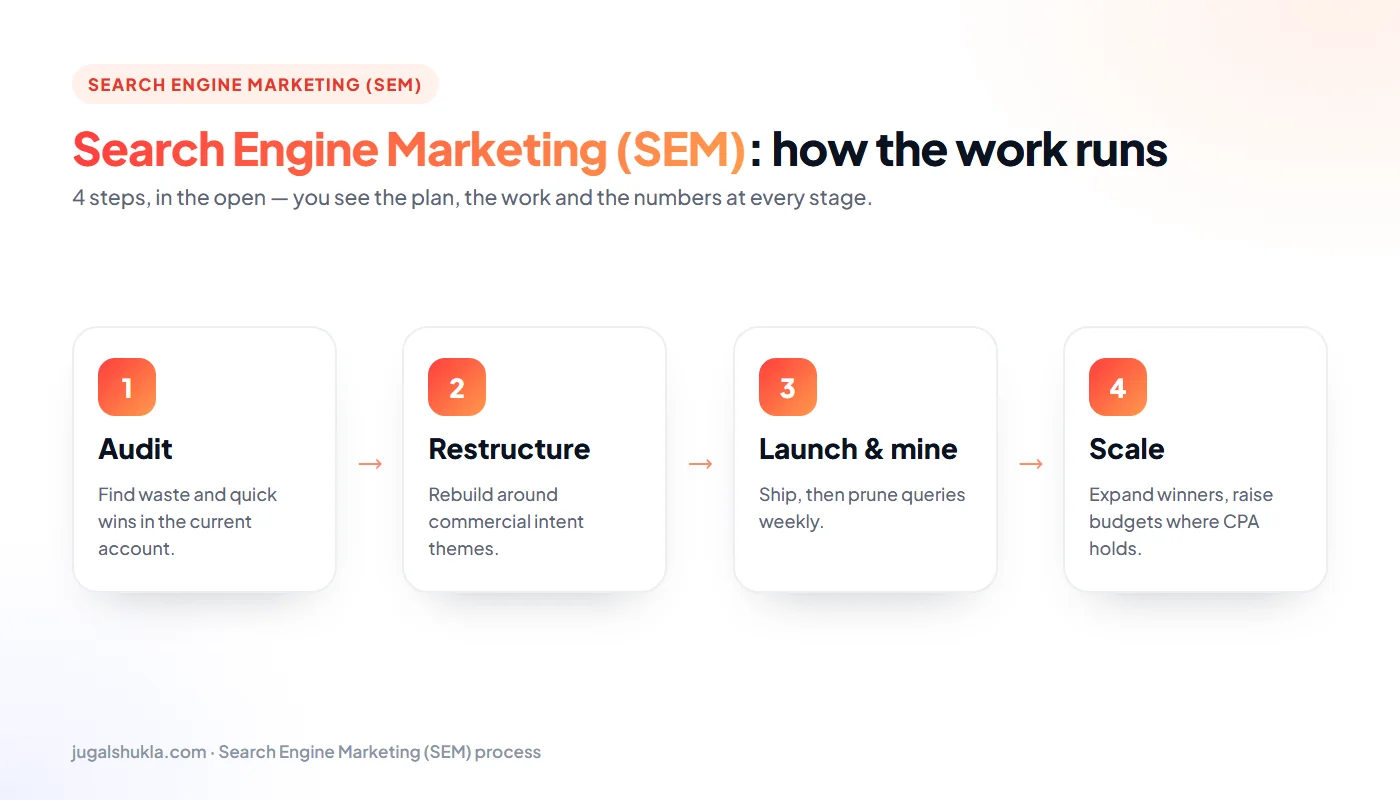
SEM process: Audit → Restructure → Launch & mine → Scale
How a Search Engine Marketing (SEM) engagement runs, step by step.
  1. Audit. For existing accounts I review the last 90 days of search terms, wasted spend, structure, Quality Scores, conversion tracking and landing pages. For new accounts I research keyword demand, competitor ads and realistic costs per click.
  2. Restructure. Campaigns are rebuilt around intent and services, with tight ad groups, fresh ads and a robust negative keyword list.
  3. Launch and mine. For the first weeks, search terms are reviewed daily. Converting searches become exact keywords; irrelevant ones become negatives.
  4. Scale. Budgets move to what converts, smart bidding takes over where data supports it, and the account expands into new keywords, locations or Microsoft Ads.

Each step builds on the one before. Scaling an account with leaky tracking and loose keywords only multiplies waste — scaling a clean account multiplies profit.

What SEM costs in India

Search engine marketing has two costs: what you pay the search engine for clicks, and what you pay for management.

Click costs depend on competition. Local service keywords in Indian cities often cost ₹10–₹60 per click; B2B, legal, finance, real estate and education terms frequently cost ₹80–₹300 or more. A practical starting budget for a small business is ₹15,000–₹30,000 a month, enough to collect data within a few weeks.

Management for search campaigns is part of my Google Ads Lead Plan, from ₹4,999* a month: account and competitor audit, campaigns, keywords and ads, call, form and WhatsApp tracking, weekly bid and negative-keyword work and a monthly cost-per-lead report. Your ad budget is paid directly to Google from your own account.

The cheapest SEM is not the one with the lowest fee — it is the one with the lowest cost per qualified lead. A well-managed account usually saves far more in wasted clicks than the management costs.

Timelines and the results to expect

Paid search is fast, but it still follows a learning curve:

  • Days 1–7: campaigns launch with tracking verified; the first leads often arrive in the first week.
  • Weeks 2–6: daily search-term mining removes waste and finds the converting searches. Costs are often volatile in this period.
  • Months 2–3: enough conversion data for smart bidding; cost per lead typically falls and becomes predictable.
  • Month 4 onwards: steady optimisation, new ad tests and controlled expansion.

A realistic goal for the first quarter is a stable, profitable cost per lead and a clear picture of which services and locations produce the best customers. That is the foundation for scaling search engine marketing with confidence.

Keyword match types and negative keywords

Match types decide how closely a search must match your keyword before your ad can show — and they are the most common source of wasted SEM budget.

  • Exact match shows your ad for searches with the same meaning as your keyword. Most control, less volume.
  • Phrase match allows extra words around the meaning of your phrase. A good balance for most accounts.
  • Broad match lets Google show ads for related searches. Powerful with smart bidding and excellent conversion data; expensive without them.

Negative keywords are the counterweight. Every account should block searches for jobs, free versions, DIY guides, competitors you do not want to pay for and irrelevant locations. I build a starting negative list before launch and add to it every week from the search terms report — the single habit that most separates good paid search management from expensive autopilot.

Quality Score and why it lowers your costs

Quality Score is Google's 1–10 rating of how relevant your keyword, ad and landing page are to each other. It matters because higher Quality Scores lower your cost per click and improve your ad positions — you can pay less than a competitor and still appear above them.

Three components drive it:

  • Expected click-through rate: how likely people are to click your ad for that keyword.
  • Ad relevance: how closely the ad matches the intent behind the search.
  • Landing-page experience: whether the page is relevant, fast, mobile-friendly and easy to use.

Tight ad groups, ads that repeat the searcher's words and fast, specific landing pages raise Quality Score over time. In many accounts I manage, improving these three factors cuts costs per click noticeably within two to three months — budget that then buys more clicks.

SEM mistakes I see in almost every audit
  • No negative keywords, so budget leaks to irrelevant searches every day.
  • Display Network left on inside search campaigns.
  • One ad group for everything, so ads cannot match specific searches.
  • Homepage as the landing page for every keyword.
  • Tracking button clicks as conversions, which misleads smart bidding.
  • No call tracking for businesses where most customers phone.
  • Location targeting set to "presence or interest", showing ads to people outside your service area.
  • Accepting auto-applied recommendations without review.

Fixing these usually lowers cost per lead within weeks — before any advanced optimisation begins.

How SEM works with SEO

Search engine marketing and SEO compete for the same searches, so planning them together saves money:

  • Keyword intelligence: paid search reveals within weeks which searches convert. SEO then targets those terms for the long term.
  • Coverage: where you rank organically in the top positions, you can test reducing paid spend; where you do not, ads fill the gap.
  • Brand protection: bidding on your brand name stops competitors from appearing above you.
  • Shared landing pages: conversion improvements lift both paid and organic results.

Most of my clients run both: SEM for predictable leads now, SEO for leads that do not cost per click later.

Questions to ask before hiring for paid search management
  • Will I own the Google Ads account and all its data?
  • How often will search terms be reviewed and negatives added?
  • How will calls, forms and WhatsApp enquiries be tracked?
  • What cost per lead do you expect in my market, and why?
  • Will you work on landing pages or only on the ads?
  • What will the monthly report show — and is lead quality part of it?
  • What is the notice period if results are not there?
Ad copy and assets that earn the click

In search engine marketing, the ad is your shop window. Responsive search ads let you supply up to 15 headlines and 4 descriptions; Google combines them for each search. The best accounts write them deliberately:

  • Keyword-matched headlines so searchers see their own words.
  • Specific benefits and proof: years of experience, reviews, results, delivery times.
  • Clear calls to action — book, call, get a quote.
  • Assets: sitelinks, callouts, structured snippets, call and location assets make ads larger and more clickable.

Ad testing is continuous in good paid search management: the weakest headlines are replaced every month with new ideas drawn from what customers actually say.

How to measure search engine marketing
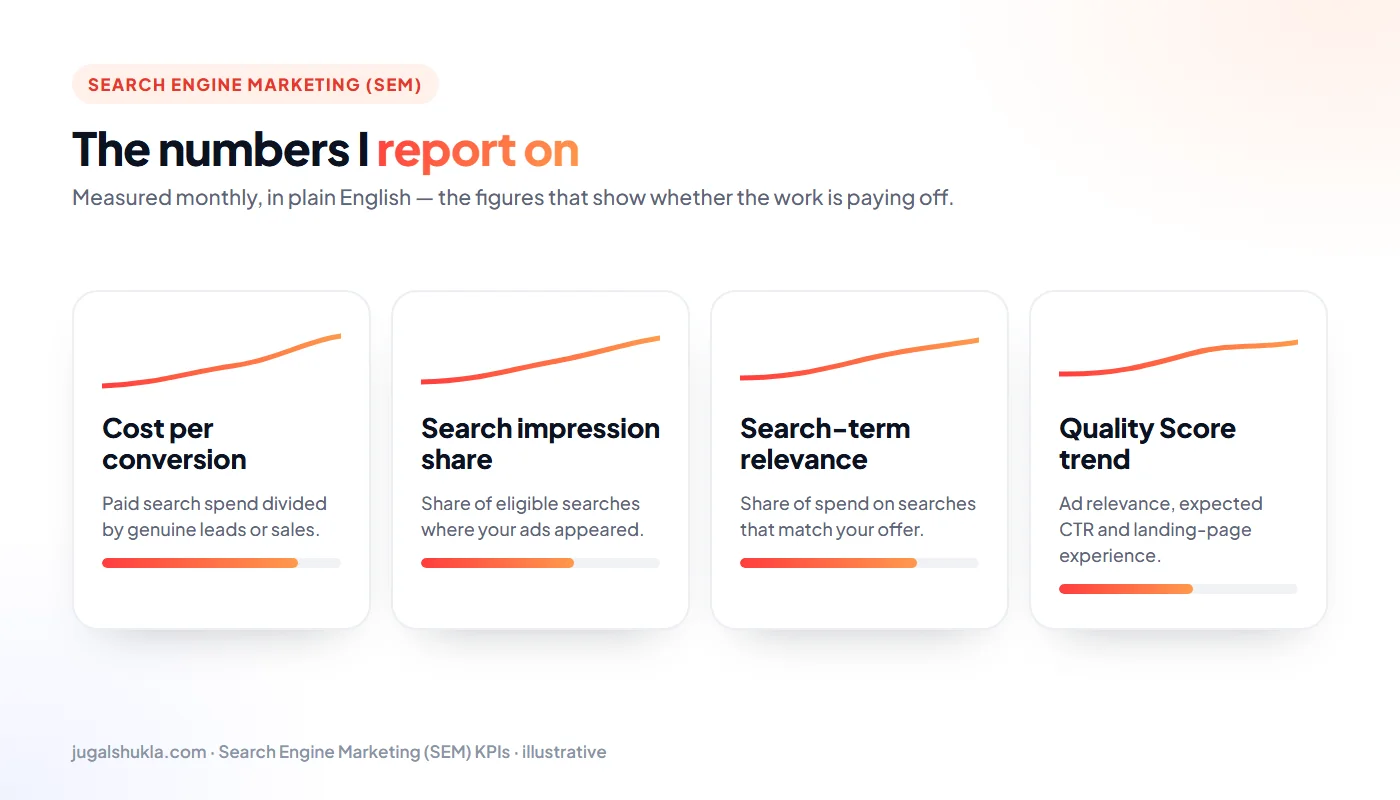
SEM KPIs: Cost per conversion, Search impression share, Search-term relevance, Quality Score trend
The numbers I report on every month (illustrative).
  • Cost per conversion: spend divided by genuine enquiries or sales — the headline number.
  • Search impression share: how often your ads appear for eligible searches, and whether budget or rank causes the misses.
  • Search-term relevance: the share of spend on searches that match your offer; it should climb every month.
  • Quality Score trend: rising scores mean cheaper clicks.

Self-check: download last month's search terms report and highlight every search you would never want to pay for. If the highlighted spend exceeds 15–20%, SEM management will almost certainly reduce your cost per lead.

FAQ

SEM questions, answered.

12 straight answers to what people ask me most about Search Engine Marketing (SEM). Still unsure? Send a quick message — I reply within 24 hours.

Still have a question?

Ask me directly — no bots, no sales team.

What's the minimum spend?

Enough to get statistically useful data — usually ₹1L/month or equivalent.

Do you manage Microsoft Ads too?

Yes, where the audience justifies it.

Who owns the account?

You do, always. I work inside your account.

Do you build the landing pages?

I brief and can build them, or work with your team.

Is SEM the same as Google Ads?

In practice, mostly. SEM means paid search on any search engine; Google Ads is the biggest platform, with Microsoft Ads adding extra reach.

How much should I budget for search engine marketing?

Many small businesses start with ₹15,000–₹30,000 a month in ad spend. Management starts at ₹4,999* a month.

What is a good cost per lead for paid search?

It depends on your industry and deal value. The right target is the cost per lead your margins and close rate can comfortably support.

Should I bid on my own brand name?

Usually yes — brand clicks are cheap and stop competitors from appearing above you.

How long does it take for SEM to work?

Leads can start in the first week; costs usually stabilise after six to ten weeks.

Do you use broad match keywords?

Only when tracking is accurate and smart bidding has enough data — otherwise phrase and exact match give more control.

Can you run Microsoft Ads as well?

Yes. It is often cheaper per click and adds useful volume once Google campaigns are profitable.

Will SEM help my SEO?

Indirectly — paid search data shows which keywords convert, so SEO effort can focus on the most valuable terms.

Next step

Want a hands-on partner, not a deck?

Tell me what you’re trying to grow. I’ll tell you honestly whether I’m the right person, and what I’d do first.

Send a quick brief

I reply within 24 hours.