Paid Ads & Performance

Performance Marketing

A cross-channel performance engine where budget follows contribution, not habit — measured on CAC and payback, not vanity metrics.

Current offer
Google + Meta

Full-Funnel Leads

One consultant running all your paid leads

₹9,999*/month management
  • Your Google and Meta campaigns run as one
  • Offer, audience and keyword strategy
  • Lead forms, CRM and WhatsApp flows
  • End-to-end conversion tracking
  • Monthly pipeline report

*Prices are starting points for a typical scope — I confirm your exact quote after a short call. GST, third-party tools and ad spend are billed separately. T&C apply.

Sound familiar?

The problems I fix.

01

Channels are optimised in silos.

02

Attribution reports contradict each other.

03

Nobody knows the true blended CAC.

What you get

Everything done, not just recommended.

Blended reporting

One view across all paid and organic sources.

Media mix model

Where the next rupee earns the most.

Attribution setup

Server-side and offline conversions where needed.

Incrementality tests

Geo and holdout tests to prove real lift.

Unit economics

CAC, LTV and payback period per channel.

Weekly cadence

Standing review with clear decisions logged.

organic traffic for a B2B brand in 6 months
0 ×
more student inquiries via SEO + paid search
0 %
years of hands-on delivery
0 +
Performance Marketing offers

Pick a starting point. Upgrade any time.

Google + Meta

Full-Funnel Leads

One consultant running all your paid leads

₹9,999*/month management
  • Your Google and Meta campaigns run as one
  • Offer, audience and keyword strategy
  • Lead forms, CRM and WhatsApp flows
  • End-to-end conversion tracking
  • Monthly pipeline report

*Prices are starting points for a typical scope — I confirm your exact quote after a short call. GST, third-party tools and ad spend are billed separately. T&C apply.

How it works

A clear process, run in the open.

01

Measure

Fix tracking so the numbers can be trusted.

02

Model

Build the CAC and payback picture.

03

Reallocate

Shift budget towards proven contribution.

04

Prove

Run incrementality tests before scaling hard.

Tools I use:GA4Looker StudioGoogle AdsMeta Business ManagerHubSpot
The complete guide

Performance marketing: the complete guide.

Everything worth knowing before you invest — what’s included, costs in India, timelines, mistakes to avoid and how to measure results. Open any chapter.

16 chaptersAbout 7 min readWritten by Jugal Kishore ShuklaUpdated October 2026
What performance marketing means

Performance marketing is marketing judged only by measurable outcomes — leads, sales, revenue and profit — rather than impressions or likes. Every rupee is tracked from the ad or campaign to the result it produces, and budget moves continuously towards whatever earns the best return.

As a performance marketing consultant, I run your paid channels as a single system:

  • Measurement first: GA4, Tag Manager, CRM integration and offline conversions so every lead and sale is attributed.
  • A unit-economics model: your margins, close rates and customer lifetime value turned into a target cost per acquisition and ROAS.
  • Channel mix: Google Ads, Meta, LinkedIn, YouTube and remarketing — chosen and weighted by contribution.
  • Creative and landing-page testing to lift conversion at every step.
  • Weekly budget reallocation based on data, not habit.
  • Reporting on revenue and payback, not platform vanity metrics.

The aim of ROAS optimization is simple: more revenue for each rupee spent, with growth that pays for itself.

Who needs a performance marketing consultant

Performance marketing suits businesses that already spend on ads — or are ready to — and want accountability for every rupee:

  • D2C and e-commerce brands managing ROAS across Google and Meta.
  • Education providers running admission campaigns across several channels.
  • B2B companies whose pipeline depends on paid lead generation.
  • Service businesses scaling beyond a single city or service line.

If you spend less than ₹30,000 a month on ads in total, start with one well-run channel. Performance marketing pays off when there is enough spend and data to optimise across channels — and when the business can share sales outcomes, so marketing is judged on revenue, not just leads.

How I run performance marketing
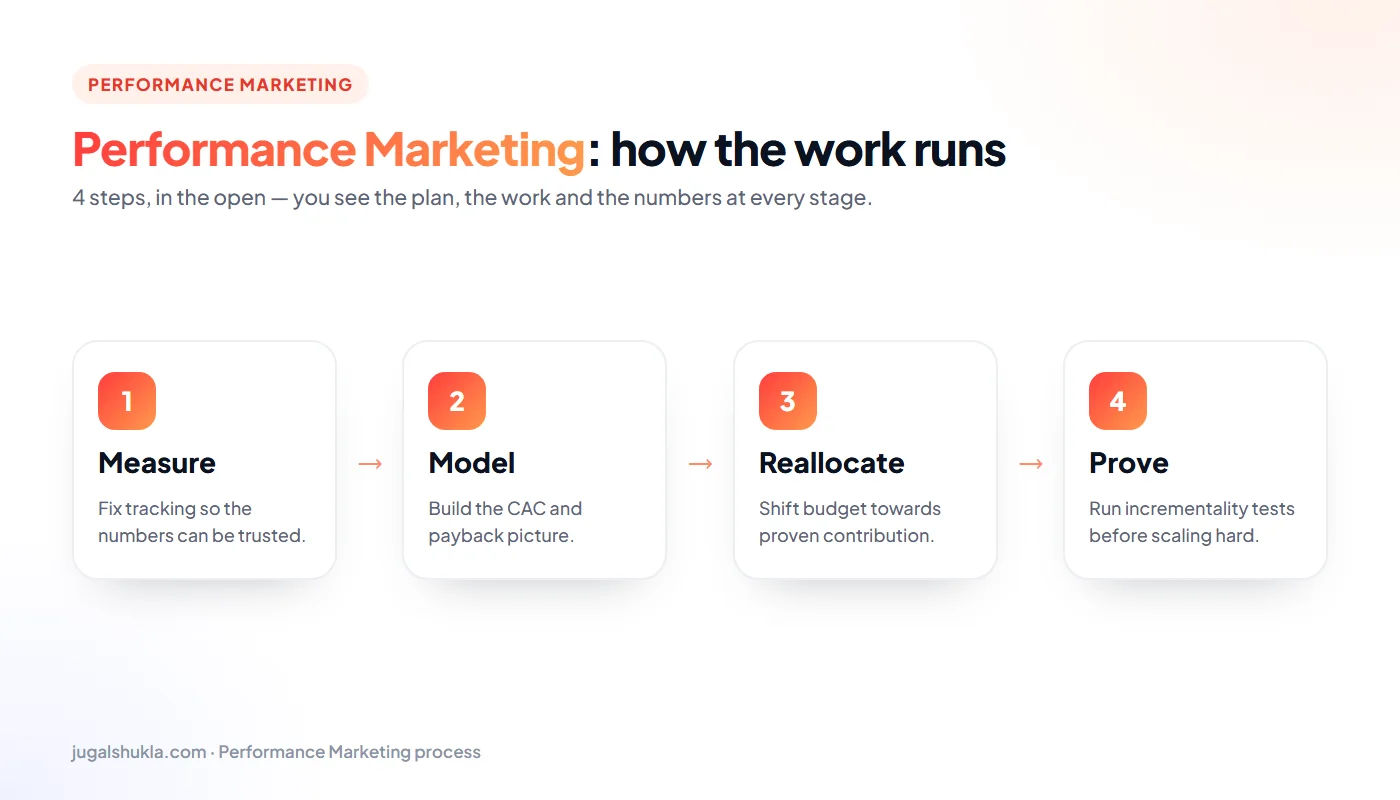
Performance marketing process: Measure → Model → Reallocate → Prove
How a Performance Marketing engagement runs, step by step.
  1. Measure. Tracking audited and rebuilt where needed, including CRM integration and offline conversion imports, so every channel is judged on the same definition of success.
  2. Model. Your unit economics turned into targets: affordable cost per lead and acquisition, target ROAS and acceptable payback period.
  3. Reallocate. Budget shifted weekly towards the campaigns and channels beating target, away from those that do not.
  4. Prove. A monthly report connecting spend to revenue, with clear recommendations for the next month.

Performance marketing is not a set-and-forget campaign. It is a weekly operating rhythm of measurement, decisions and tests.

What performance marketing costs

Costs depend on how many channels you run and how much you spend. Indian performance marketing agencies often charge 10–20% of ad spend or a fixed retainer; I work on a fixed fee so my recommendations are never influenced by how much you spend.

My Full-Funnel Leads plan starts at ₹9,999* a month and covers Google and Meta campaigns run as one, offer, audience and keyword strategy, lead forms, CRM and WhatsApp flows, end-to-end conversion tracking and a monthly pipeline report. Ad spend is paid directly to the platforms from your accounts.

Before increasing budgets, I always check whether the money would earn more by improving tracking, landing pages or follow-up — often the cheapest performance gains available.

Timelines and results
  • Month 1: tracking and attribution fixed, targets set, obvious waste removed — often an immediate efficiency gain.
  • Months 2–3: structured tests across channels, creative and landing pages; budget concentrates on winners.
  • Months 4–6: stable performance against targets and confident scaling of the channels that pay back fastest.

The headline result is not a single campaign record but a business that knows exactly what it costs to win a customer — and can grow by spending more with confidence.

Attribution: knowing which channel really works

Every ad platform claims credit for the same sale. Meta reports a conversion, Google reports the same conversion, and your total "reported" revenue exceeds your actual revenue. Performance marketing needs a single source of truth.

  • GA4 with clean UTM tagging gives a consistent cross-channel view.
  • CRM data shows which leads actually became customers, and at what value.
  • Blended metrics — total spend against total new customers or revenue — keep everyone honest.
  • Incrementality tests: pausing a channel in one region or for a period shows what it truly adds.

I report platform numbers for optimisation but make budget decisions on blended and CRM-verified results. That is what separates performance marketing from simply running ads on several platforms.

ROAS optimization: beyond cheaper clicks

Raising return on ad spend rarely comes from bidding tricks. The biggest levers sit around the ads:

  • Offer: bundles, guarantees and clear pricing often lift conversion more than any targeting change.
  • Landing pages and checkout: faster pages and fewer steps increase conversion rate on every channel.
  • Average order value: upsells and thresholds raise revenue per conversion.
  • Retention: repeat purchases improve the economics of every acquired customer.
  • Feeding value back: sending actual revenue to Google and Meta lets their algorithms chase high-value customers.

When these improve, the same ad budget produces more revenue — ROAS optimization at the level of the business, not just the campaign.

Performance marketing mistakes
  • Trusting platform-reported ROAS without checking real revenue.
  • Scaling budgets before tracking is correct.
  • Judging channels on last click only, starving the channels that create demand.
  • Optimising for lead volume while sales complain about lead quality.
  • No creative refresh — results decay as ads fatigue.
  • Ignoring payback period, so growth drains cash flow.
Questions to ask a performance marketing consultant
  • How will you measure results across channels without double counting?
  • Will you use our CRM or sales data to judge lead quality?
  • How do you decide when to move budget between channels?
  • Is your fee fixed or a percentage of spend?
  • What will you change in the first 30 days?
  • Do we keep ownership of every account and dashboard?
Creative testing: the engine of performance

On Meta, YouTube and increasingly on Google, targeting is largely automated — so creative has become the main lever a performance marketing consultant can pull. A structured testing system beats occasional "new ads":

  • Test concepts, not colours. Different angles — price, speed, proof, fear of missing out, founder story — produce far bigger differences than small design tweaks.
  • Make variations of winners. When an angle works, test new hooks, formats and lengths around it.
  • Refresh before fatigue. Frequency and falling click-through rates warn that results are about to decline.
  • Keep a creative log of what was tested and learned, so knowledge builds over time.

Creative testing is where ROAS optimization usually finds its biggest gains once tracking and budgets are in order.

Scaling budgets without breaking results

Increasing ad spend often raises the cost per result, because each extra rupee reaches slightly less interested people. Performance marketing scales carefully:

  • Raise budgets gradually — around 20% at a time — so algorithms can adjust.
  • Scale horizontally into new audiences, keywords, locations and channels, not only vertically on one campaign.
  • Watch marginal returns: what the last ₹10,000 delivered, not just the average.
  • Protect cash flow by checking payback period before every major increase.

The aim is profitable growth: scaling until the marginal return reaches your target, then improving offer, creative and conversion to push that limit further.

Landing pages and the post-click journey

Performance marketing does not end at the click. Landing pages, forms, checkout and follow-up decide how much of your ad spend becomes revenue. I review the full post-click journey every month: page speed, message match with each ad, form completion rates, response times to leads and the abandoned-cart or nurture sequence. Fixing a weak step improves results on every channel at once — the most capital-efficient optimisation available.

Unit economics: the numbers behind every target

Performance marketing targets should come from your business numbers, not industry averages. Four figures do most of the work:

  • Average order or deal value — what a typical customer spends on the first purchase.
  • Gross margin — what remains after product or delivery costs.
  • Close rate — how many leads become customers.
  • Lifetime value — what a customer is worth over repeat purchases.

From these, I calculate the maximum affordable cost per lead and acquisition, and the break-even ROAS. Campaigns are then judged against targets that guarantee profit rather than vanity benchmarks. When margins or close rates improve, targets loosen and budgets can grow — which is why performance marketing works best when marketing and sales share the same numbers.

Reporting a performance marketing consultant should provide

Every month you should see spend, leads, customers and revenue by channel; blended cost per acquisition and ROAS against target; what changed and why; tests run and their results; and the plan for next month. Short, honest and focused on money — that is the standard for performance reporting.

Remarketing in performance marketing

Most visitors do not convert on their first visit. Remarketing shows relevant ads to people who visited your website, watched your videos or engaged with your social content, bringing them back when they are ready. Effective remarketing uses different messages for different behaviour: proof and reviews for people who viewed services, reminders and offers for those who started a form or checkout, and new content for past customers. Frequency caps stop ads from becoming irritating. Because these audiences already know you, remarketing usually delivers some of the lowest costs per acquisition in a performance marketing programme.

How to measure performance marketing
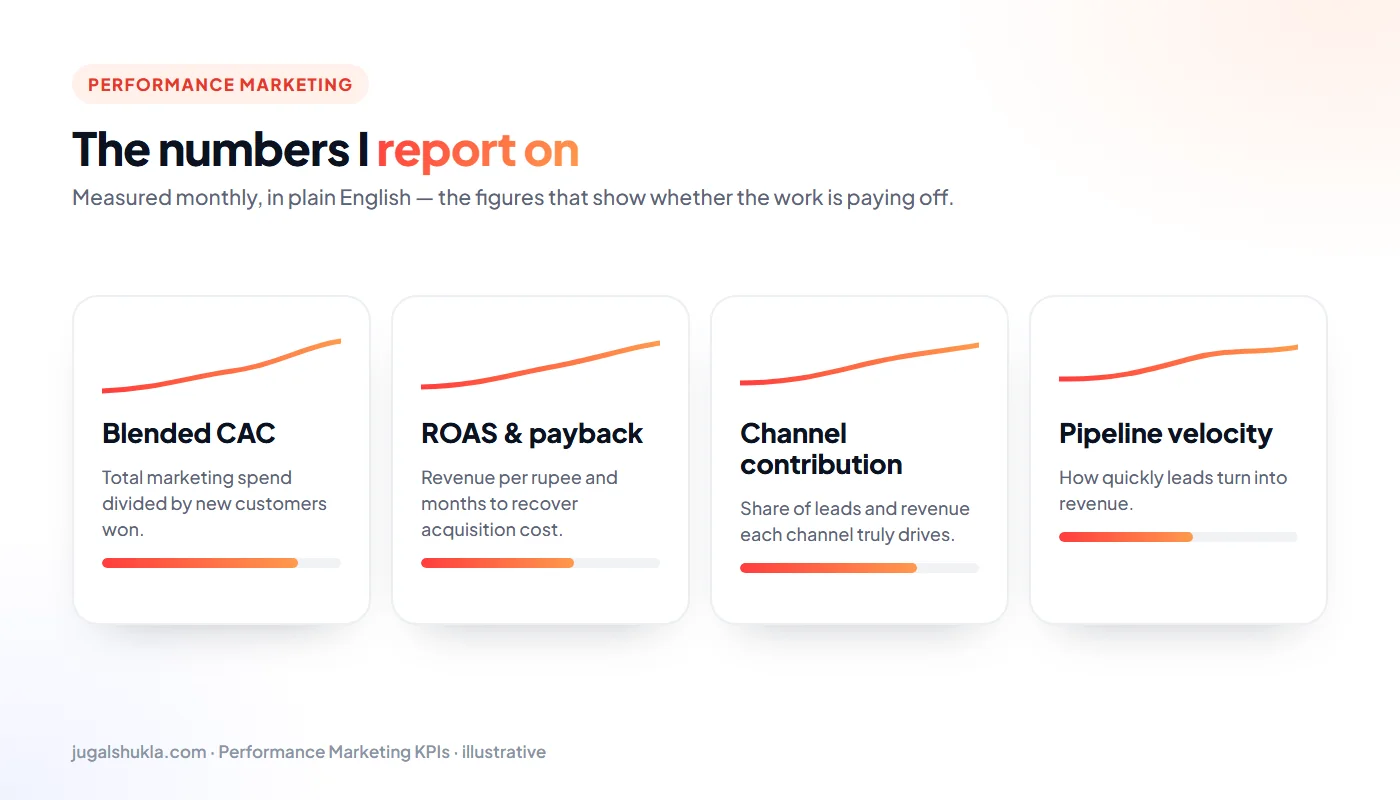
Performance marketing KPIs: Blended CAC, ROAS & payback, Channel contribution, Pipeline velocity
The numbers I report on every month (illustrative).
  • Blended customer acquisition cost: total marketing spend divided by new customers.
  • ROAS and payback period: revenue per rupee spent, and how many months it takes to recover acquisition cost.
  • Channel contribution: leads and revenue by channel using one consistent attribution view.
  • Pipeline velocity: how quickly leads move to revenue — critical for cash flow.

Self-check: if you cannot say what it cost to acquire a customer last month across all channels, performance marketing should start with measurement — before any new campaign.

FAQ

Performance marketing questions, answered.

11 straight answers to what people ask me most about Performance Marketing. Still unsure? Send a quick message — I reply within 24 hours.

Still have a question?

Ask me directly — no bots, no sales team.

Is this different from PPC?

PPC manages channels. Performance marketing manages the portfolio across all of them.

Do you need a CRM?

Strongly preferred — offline conversion data makes optimisation far sharper.

What size budgets suit this?

It pays off from roughly ₹5L/month in combined media spend.

What is the difference between performance marketing and digital marketing?

Digital marketing covers everything online. Performance marketing is the part judged strictly on measurable results like leads, sales and ROAS.

Which channels are included?

Usually Google Ads and Meta, plus LinkedIn, YouTube and remarketing where they pay back — chosen by contribution, not habit.

Do you charge a percentage of ad spend?

No. A fixed fee from ₹9,999* a month, so budget advice is independent of my fee.

What is a good ROAS?

It depends on your margins. A 3× ROAS can be excellent for one business and loss-making for another — I set targets from your unit economics.

How do you handle attribution?

Platform data for optimisation, GA4 and CRM data for decisions, plus incrementality tests where budgets allow.

Can you work with our in-house team?

Yes — I can run the strategy and measurement while your team handles execution, or manage everything directly.

How soon will performance improve?

Tracking fixes and waste removal often help within the first month; sustained gains come over two to three months of testing.

Do you need access to our sales data?

It helps enormously. Even a weekly sheet of which leads converted lets campaigns optimise for revenue instead of form fills.

Next step

Want a hands-on partner, not a deck?

Tell me what you’re trying to grow. I’ll tell you honestly whether I’m the right person, and what I’d do first.

Send a quick brief

I reply within 24 hours.