Full-Funnel Leads
One consultant running all your paid leads
- Your Google and Meta campaigns run as one
- Offer, audience and keyword strategy
- Lead forms, CRM and WhatsApp flows
- End-to-end conversion tracking
- Monthly pipeline report
Ecommerce marketing that grows revenue per session — Google Shopping, Meta and SEO run as one plan, judged on profit, not clicks.
One consultant running all your paid leads
*Prices are starting points for a typical scope — I confirm your exact quote after a short call. GST, third-party tools and ad spend are billed separately. T&C apply.
Titles, attributes, images and disapproval fixes.
Structured by margin and intent, not one big bucket.
Pages that rank and merchandise at once.
Email and WhatsApp abandonment flows.
Post-purchase, replenishment and win-back sequences.
Contribution margin, not just ROAS.
One consultant running all your paid leads
Your own store, no marketplace cut
*Prices are starting points for a typical scope — I confirm your exact quote after a short call. GST, third-party tools and ad spend are billed separately. T&C apply.
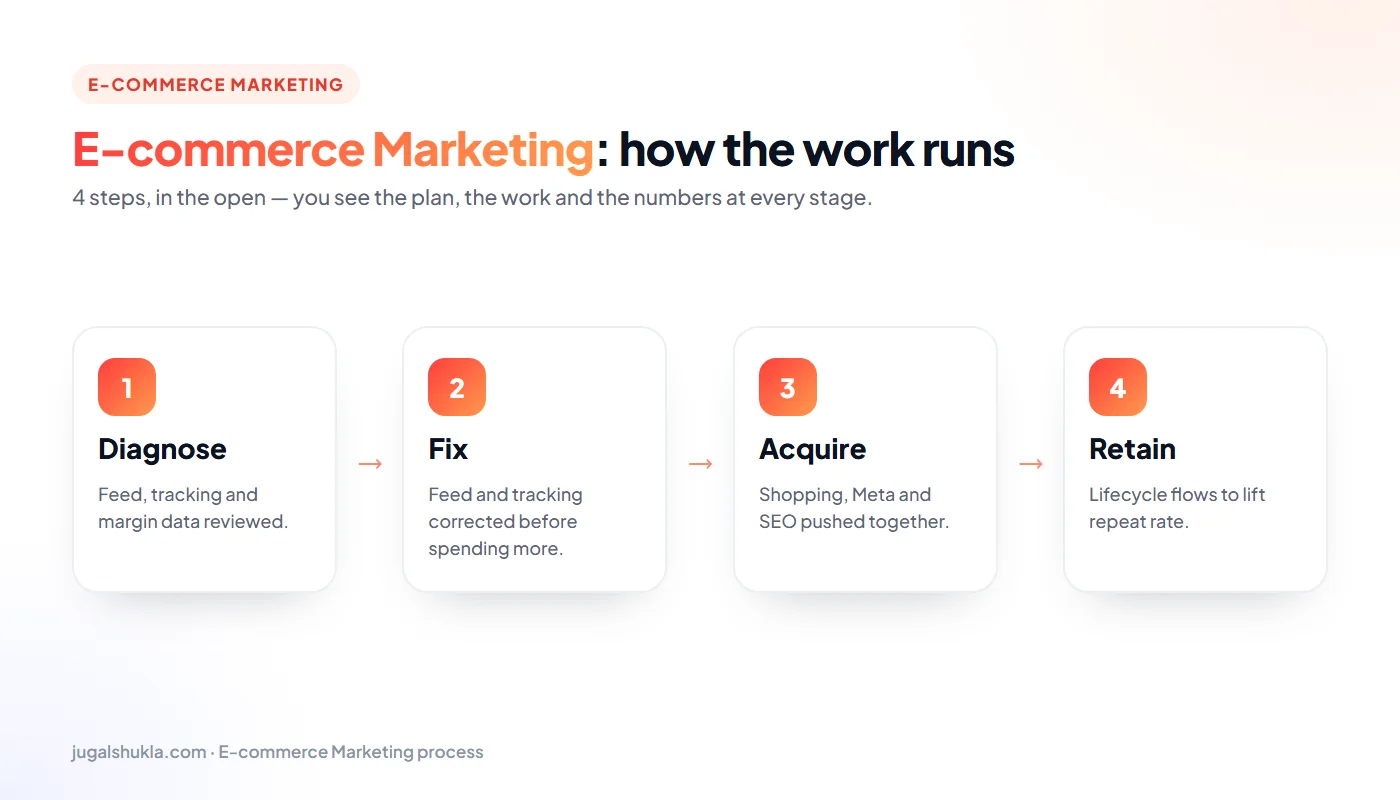
Feed, tracking and margin data reviewed.
Feed and tracking corrected before spending more.
Shopping, Meta and SEO pushed together.
Lifecycle flows to lift repeat rate.
Everything worth knowing before you invest — what’s included, costs in India, timelines, mistakes to avoid and how to measure results. Open any chapter.
Ecommerce marketing brings the right shoppers to your online store, helps them buy and brings them back for more. Growing an online store profitably means working on three things at once: acquisition (traffic), conversion (the store experience) and retention (repeat customers).
A complete ecommerce marketing programme covers:
The goal is not more traffic — it is more revenue per session and more profit per customer.
Before scaling ads, a store needs a working product feed, reliable tracking and product pages that convert. If those are missing, the first month goes into fixing them — otherwise ad spend buys traffic the store cannot convert.

Ecommerce marketing budgets depend on product margins, average order value and growth goals. Many Indian D2C brands start with ₹30,000–₹1,50,000 a month in ad spend across Google and Meta.
Management for ecommerce campaigns is part of my Full-Funnel Leads plan, from ₹9,999* a month, adapted for stores: Google and Meta run as one, product feed and catalogue optimisation, conversion tracking and monthly revenue reporting. If you need a new store first, see WooCommerce or Shopify development.
The key number is contribution margin after ad costs — a high ROAS on low-margin products can still lose money, so campaigns are structured around profit, not just revenue.

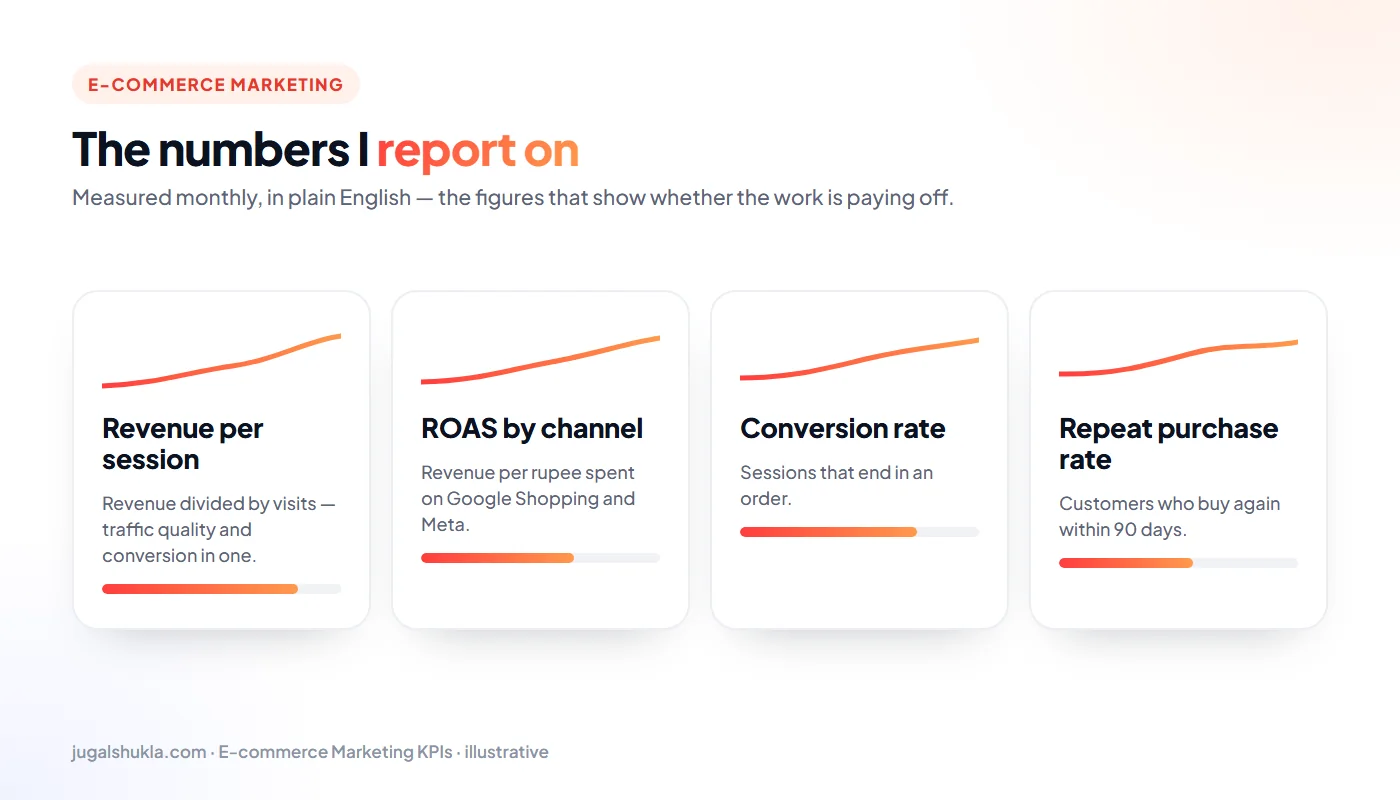
The target I set with store owners is usually revenue per session, not traffic: the measure that captures both better shoppers and a better store.
For most online stores, Google Shopping ads and Performance Max are the most profitable paid channel — but only with a strong product feed. The feed is effectively your ad copy.
Feed improvements alone frequently raise Shopping click-through and conversion rates before any bidding changes.
Ecommerce SEO brings shoppers who search for products without paying per click. The highest-value pages are usually categories, not individual products, because they match broader buying searches.
Meta Ads — Facebook and Instagram — are where most shoppers discover products they were not searching for. For ecommerce marketing they play three roles:
Creative is the main lever: user-generated videos, unboxing clips, before-and-after comparisons and clear offers usually outperform polished catalogue photos. Meta campaigns also need the Conversions API alongside the pixel so purchases are tracked accurately.
Ecommerce marketing spends money to bring shoppers to the store, so every improvement in conversion rate makes every channel more profitable. The highest-impact fixes are usually:
Acquiring a customer costs far more than keeping one, and repeat customers usually spend more. Automated flows do most of the retention work:
Set up once, these flows earn revenue every day and lift the lifetime value that makes Google Shopping ads and Meta campaigns more affordable.
ROAS measures revenue per rupee of ad spend, but it ignores product costs, shipping, returns and discounts. A store can show a 4× ROAS and still lose money on low-margin products. I calculate break-even ROAS for each product group and structure Google Shopping ads and Meta campaigns around contribution margin — so budget flows to the products that actually make you money, and ecommerce SEO effort targets the most profitable categories first.
For Indian online stores, festive seasons — Diwali, Raksha Bandhan, wedding season, end-of-season sales — can produce a large share of annual revenue. Ecommerce marketing for these peaks starts weeks ahead: building audiences and email lists, preparing creative and offers, checking stock and delivery capacity, and raising Google Shopping ads and Meta budgets before competition drives up costs. After the peak, retention flows turn festive first-time buyers into repeat customers.
Amazon, Flipkart and other marketplaces bring huge reach but take commissions and keep customer relationships. Your own store keeps margins and data. Many brands use marketplaces for discovery and their own store for repeat customers, bundles and exclusive products — with ecommerce SEO, email and WhatsApp bringing shoppers back directly.
Shoppers trust other shoppers. Product reviews, customer photos, unboxing videos and ratings raise conversion rates on product pages, improve click-through on Google Shopping ads when ratings are shown, and provide some of the best-performing creative for Meta. Ask for reviews automatically a few days after delivery, make it easy to add photos, respond to negative reviews constructively and feature the best customer content across the store, social media and ads. Review schema on product pages can also bring star ratings into Google results — a quiet but steady boost for ecommerce SEO and click-through.
Raising average order value makes every marketing channel more profitable, because the cost of acquiring the order stays roughly the same. Product bundles, "frequently bought together" suggestions, free-shipping thresholds just above the typical basket and post-purchase one-click offers are proven ways to lift it. Test each offer and watch margin as well as revenue.

Self-check: what share of last month's revenue came from returning customers? If it is under 20%, retention flows are probably the quickest ecommerce marketing win available.
11 straight answers to what people ask me most about E-commerce Marketing. Still unsure? Send a quick message — I reply within 24 hours.
Ask me directly — no bots, no sales team.
Shopify, WooCommerce, Magento and custom builds.
Amazon and Flipkart advertising, yes — at a strategy and structure level.
It depends entirely on margin. I set the target from your unit economics.
Google Shopping ads and Performance Max for shoppers already searching, and Meta catalogue ads for discovery and retargeting. Most stores need both.
Optimising category and product pages, structured data and site architecture so your products rank in Google without paying per click.
Yes — tracking, feeds, ads, SEO and retention for both platforms.
With timed email, SMS and WhatsApp reminders, clearer shipping information and checkout improvements.
It depends on margins. I calculate a break-even ROAS from your product costs and set targets above it.
Usually both — marketplaces for reach, your own store for margin and customer relationships.
Many D2C brands start at ₹30,000–₹1,50,000 a month across Google and Meta, depending on order value and goals.
Yes — feed errors, policy issues and website requirements are part of the diagnosis.
Tell me what you’re trying to grow. I’ll tell you honestly whether I’m the right person, and what I’d do first.
I reply within 24 hours.
I’ll personally review your website and send the 5 fixes that will move leads the most — within 48 hours.
Takes 20 seconds. I reply within 24 hours.
No spam, no lists. Your details are only used to reply to you.