Growth, Automation & Brand

Digital Marketing Strategy

Stop guessing which channel to feed. I map your funnel, pick the two or three levers that actually move pipeline, and sequence them.

Current offer
Free

Free Growth Call

30 minutes. Your numbers. A clear next step.

Freefree call
  • Funnel and channel review
  • The two or three levers to pull first
  • Honest fit check — no hard sell
  • Written summary after the call

*Prices are starting points for a typical scope — I confirm your exact quote after a short call. GST, third-party tools and ad spend are billed separately. T&C apply.

Sound familiar?

The problems I fix.

01

You're running five channels and none of them are owned.

02

Every agency pitch sounds the same and none start with your numbers.

03

You can't say which activity produced last quarter's revenue.

What you get

Everything done, not just recommended.

Funnel mapping

Awareness to revenue, with the leak points marked.

Audience & ICP

Who actually buys, what they search, what stops them.

Channel scoring

Each channel rated on cost, speed and compounding value.

Budget model

Spend split by channel with expected CPL and payback.

Roadmap

Quarter-by-quarter sequence, owner and success metric per item.

Measurement plan

The four numbers we report on, and how they’re tracked.

organic traffic for a B2B brand in 6 months
0 ×
more student inquiries via SEO + paid search
0 %
years of hands-on delivery
0 +
Digital Marketing Strategy offers

Pick a starting point. Upgrade any time.

Free

Free Growth Call

30 minutes. Your numbers. A clear next step.

Freefree call
  • Funnel and channel review
  • The two or three levers to pull first
  • Honest fit check — no hard sell
  • Written summary after the call

*Prices are starting points for a typical scope — I confirm your exact quote after a short call. GST, third-party tools and ad spend are billed separately. T&C apply.

How it works

A clear process, run in the open.

01

Discovery

Interviews, data pulls, access to analytics and ad accounts.

02

Diagnosis

Where growth is blocked, ranked by cost of inaction.

03

Strategy

A single-page plan plus the detail behind it.

04

Handover

Walkthrough session, then optional delivery by me.

Tools I use:GA4Search ConsoleSEMrushLooker StudioHubSpot
The complete guide

Digital marketing strategy: the complete guide.

Everything worth knowing before you invest — what’s included, costs in India, timelines, mistakes to avoid and how to measure results. Open any chapter.

15 chaptersAbout 7 min readWritten by Jugal Kishore ShuklaUpdated October 2026
What a digital marketing strategy includes

A digital marketing strategy is a written decision about where your business will compete online, who it will win and how — with the budget, channels, messages and numbers that make it happen. It is the difference between doing "a bit of everything" and doing the few things that move revenue.

When I build a digital marketing strategy with a client, it covers:

  • Goals in business terms: leads, sales, revenue and acceptable cost per customer — not followers or impressions.
  • Customer clarity: who buys, what triggers the search, what they compare and what makes them choose.
  • Positioning and offer: why someone should pick you, stated in words customers actually use.
  • Channel choice: SEO, Google Ads, Meta, LinkedIn, email, content or partnerships — ranked by expected return.
  • Funnel and conversion: how visitors become enquiries and enquiries become customers.
  • Measurement: tracking, dashboards and the few numbers reviewed every month.
  • A 90-day digital marketing plan: who does what, by when, with what budget.

The output is short and practical: a document your team can act on next week, not a hundred-slide deck that sits in a folder.

Who needs a digital marketing plan

A digital marketing plan helps most when a business is at a turning point:

  • Spending without clarity — money goes into ads, agencies and posts, but nobody can say what is working.
  • Growing beyond referrals — word of mouth built the business, but it is no longer enough.
  • Launching a new product, location or service line.
  • Building an in-house team that needs direction, priorities and standards.
  • Changing agencies and wanting an independent view before signing.

If you only need one channel fixed — say, Google Ads that are wasting money — you may not need a full strategy. A good marketing consultant will tell you that honestly rather than sell you a bigger project.
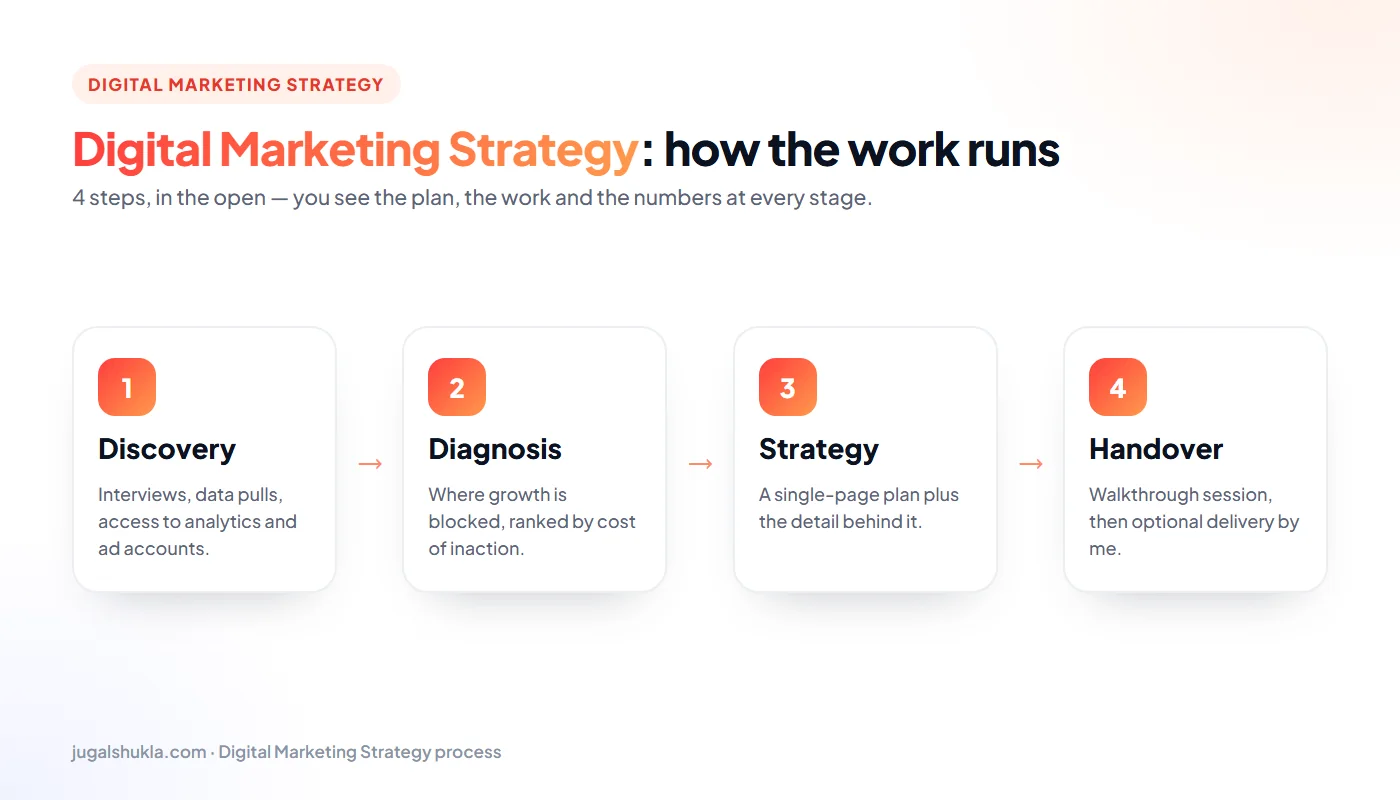
How I build your digital marketing strategy
Digital marketing strategy process: Discovery → Diagnosis → Strategy → Handover
How a Digital Marketing Strategy engagement runs, step by step.
  1. Discovery. Interviews with you and your sales team, a look at your numbers, customers, competitors and current marketing.
  2. Diagnosis. Analytics, ad accounts, website, search visibility and funnel reviewed to find the real constraints — often tracking, offer or follow-up rather than traffic.
  3. Strategy. Positioning, channel priorities, budget split, targets and a 90-day digital marketing plan with clear owners.
  4. Handover. A working session with your team, templates and dashboards — plus the option for me to run the plan with you.

Every recommendation is tied to a number you can check later. If a channel cannot be measured, it gets a small test budget until it can.

What a marketing consultant costs

Strategy work in India ranges from free "audits" that are really sales pitches to large consultancy projects. What matters is whether the advice is independent and specific to your business.

I start every engagement with a Free Growth Call: 30 minutes on your numbers, a review of your funnel and channels, the two or three levers worth pulling first and an honest fit check — followed by a written summary. If a full digital marketing strategy is the right next step, I quote a fixed fee based on scope, so there are no surprises.

Many clients then ask me to run part or all of the plan — SEO, ads, automation or analytics — on a monthly basis. That keeps strategy and execution in the same hands, so nothing gets lost between the plan and the work.

Timelines and the results to expect
  • Weeks 1–2: discovery, data access and diagnosis.
  • Weeks 3–4: strategy and 90-day plan agreed; quick wins such as tracking fixes and wasted spend start immediately.
  • Months 2–3: priority channels launched or rebuilt; first results reviewed against targets.
  • Month 3 onwards: a quarterly review rolls the plan forward based on what worked.

Results depend on the channels chosen. Paid search can produce leads within weeks; SEO usually compounds over six to twelve months. In one engagement, combining SEO with paid search produced 35% more student inquiries — the gain came from making the channels work together rather than from either one alone.

Choosing the right channels

The most common strategic mistake is choosing channels by fashion rather than by where customers are and what they are ready to do. A simple framework helps:

  • Demand already exists (people search for what you sell): Google Ads for speed, SEO and Local SEO for long-term, lower-cost leads.
  • Demand must be created (new or unfamiliar products): Meta, YouTube and LinkedIn to reach the right audiences with a strong message.
  • Long or complex sales: content, email nurturing and LinkedIn to build trust over time.
  • Repeat purchases: email, WhatsApp and loyalty to grow lifetime value.

Most small and mid-sized businesses should start with two channels done well, rather than six done badly. A digital marketing strategy decides which two — and when to add a third.

Budget: how much to spend and where

There is no universal percentage of revenue to spend on marketing. A better method starts from the numbers:

  1. Work out what a new customer is worth over a year or their lifetime.
  2. Decide how much of that you can afford to spend to win them.
  3. Estimate realistic costs per lead and close rates for each channel.
  4. Set the budget to hit your growth target — and test before committing all of it.

Your digital marketing plan should also reserve 10–20% of budget for testing new channels, offers and creatives. Without testing, a plan slowly stops working as markets change.

Positioning and messaging

The best channel strategy fails if your message sounds like everyone else's. Positioning answers three questions in plain language:

  • Who exactly is this for? Narrower usually converts better.
  • What problem do you solve, and what changes for them?
  • Why you rather than an alternative? Proof, specialisation, speed, price or guarantee.

I pull positioning from real customer language — reviews, sales calls and search queries — and test it in ads and landing pages, where results show quickly which message works.

Digital marketing strategy mistakes
  • Goals that are not business goals — likes and impressions instead of leads and revenue.
  • No tracking, so decisions rely on opinions.
  • Too many channels at once with too little budget each.
  • Copying competitors instead of differentiating.
  • A plan with no owners or dates, which quietly never happens.
  • Ignoring sales follow-up, where many leads are lost.
Questions to ask a marketing consultant
  • How will you measure whether the strategy is working?
  • Which channel would you not recommend for us, and why?
  • Will the plan be specific enough for my team to act on?
  • Can you also execute, or only advise?
  • What will you need from us — access, time, data?
  • How often will the plan be reviewed and updated?
The funnel: from stranger to customer

Every digital marketing strategy needs a clear picture of the journey a customer takes. A simple funnel has four stages, and each needs different marketing:

  • Awareness: people who do not know you yet. Social media, video, content and broad ads introduce your business.
  • Consideration: people comparing options. Search results, reviews, case studies, comparison pages and remarketing help them choose.
  • Conversion: people ready to act. Clear offers, fast landing pages, short forms, WhatsApp and quick responses win the enquiry.
  • Retention and referral: customers who can buy again or recommend you. Email, WhatsApp, loyalty offers and review requests grow their value.

Most businesses over-invest in one stage and neglect the others. A balanced digital marketing plan finds the weakest stage — often conversion or follow-up — and fixes it first, because improving the leakiest step lifts the results of everything above it.

Building the 90-day digital marketing plan

Strategy becomes real when it turns into a short, dated plan. I write every digital marketing plan as a 90-day sprint with:

  • Three to five priorities, each tied to a measurable target.
  • Weekly actions with a named owner — you, your team, an agency or me.
  • A budget by channel and month, including a small testing reserve.
  • Dependencies: what must happen first, such as tracking or a new landing page.
  • A review rhythm: a 30-minute monthly check of numbers and a quarterly planning session.

Ninety days is long enough to see results from most channels and short enough to change direction without wasting a year. At the end of each quarter, the plan is rolled forward: double down on what worked, fix or drop what did not, and add the next opportunity.

In-house team, agency or consultant?

Once the digital marketing strategy is clear, the next question is who should do the work. Each option suits a different situation:

  • In-house team: best for daily content, social media and close knowledge of the business. Harder to cover specialist skills such as paid search, analytics and technical SEO.
  • Agency: broad capacity and many hands, but strategy is often handled by senior people while execution goes to juniors.
  • Independent marketing consultant: senior strategy and hands-on execution from the same person, with direct communication and no account-manager layer.

Many growing businesses combine them: a marketing consultant sets strategy, runs specialist channels and coaches an in-house executive who handles day-to-day content. The plan should state clearly who owns what, so nothing falls between the gaps.

Using AI responsibly in your marketing

AI tools can speed up research, drafting, reporting and analysis — but they work best inside a clear digital marketing strategy, not as a replacement for one. I use AI where it saves time without lowering quality: summarising customer feedback, drafting first versions of content for human editing, building reports and spotting patterns in data. Positioning, offers, budget decisions and anything customers read in its final form still need human judgement and real expertise.
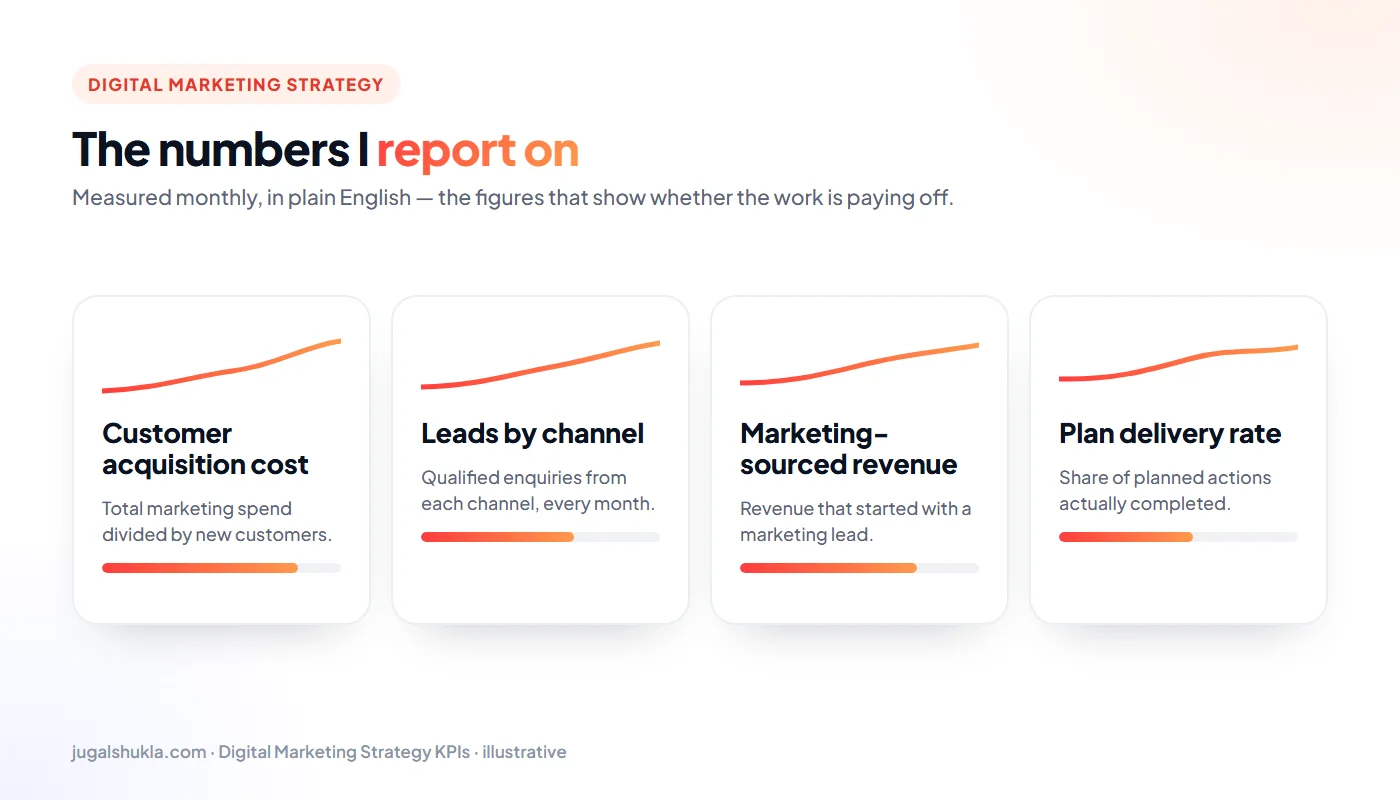
How to measure your digital marketing strategy
Digital marketing strategy KPIs: Customer acquisition cost, Leads by channel, Marketing-sourced revenue, Plan delivery rate
The numbers I report on every month (illustrative).
  • Customer acquisition cost — total marketing spend divided by new customers.
  • Leads by channel — qualified enquiries from each channel every month.
  • Marketing-sourced revenue — revenue from customers whose journey started with marketing.
  • Plan delivery rate — how much of the planned work actually happened.

Self-check: can you name the channel that brought your last ten customers? If not, the first step of any digital marketing strategy is measurement.

FAQ

Digital marketing strategy questions, answered.

12 straight answers to what people ask me most about Digital Marketing Strategy. Still unsure? Send a quick message — I reply within 24 hours.

Still have a question?

Ask me directly — no bots, no sales team.

Is this a deck or an implementation?

The strategy is a deliverable on its own. If you want me to build it too, that becomes a retainer or sprint.

How long does it take?

Typically two to three weeks from access to final walkthrough.

Do I need existing data?

Helpful, not required. If tracking is broken, fixing it becomes step one.

Will you work with my in-house team?

Yes — most strategies are built to be run by an internal team with me reviewing.

What is the difference between a digital marketing strategy and a digital marketing plan?

The strategy decides where and how you will compete; the plan turns it into dated actions, owners and budgets. I deliver both together.

How long does it take to build a digital marketing strategy?

Usually three to four weeks, including discovery, diagnosis and a 90-day plan.

Do you also execute the plan?

Yes. Many clients ask me to run SEO, ads, automation or analytics after the strategy, so strategy and execution stay with one person.

Is the first call really free?

Yes. The Free Growth Call is 30 minutes on your numbers with a written summary afterwards — no obligation.

Can a small business benefit from a marketing consultant?

Often the most. Small budgets need sharper choices, and an independent marketing consultant helps avoid expensive mistakes.

Which channel should I start with?

It depends on whether demand already exists. If people search for what you sell, Google Ads and SEO usually come first.

Will you work with my existing agency?

Yes — I can set direction and targets, review their work and help you hold everyone to clear numbers.

How often should a strategy be updated?

Review results monthly and roll the plan forward every quarter.

Next step

Want a hands-on partner, not a deck?

Tell me what you’re trying to grow. I’ll tell you honestly whether I’m the right person, and what I’d do first.

Send a quick brief

I reply within 24 hours.