Growth, Automation & Brand

Conversion Rate Optimisation

CRO that gets more from the traffic you already pay for — research, A/B tests and page fixes that lift enquiries and sales.

Current offer
Fee credited

Deep SEO Audit

Know exactly why you're not ranking

₹1,999*incl. GST
  • Technical, on-page and backlink review
  • Competitor and keyword gap analysis
  • Speed, indexing and schema checks
  • Prioritised fix list with effort levels
  • Fee credited if you hire me after

*Prices are starting points for a typical scope — I confirm your exact quote after a short call. GST, third-party tools and ad spend are billed separately. T&C apply.

Sound familiar?

The problems I fix.

01

Traffic is fine but conversion is stuck.

02

Redesigns are decided by whoever is loudest.

03

Tests get called after four days.

What you get

Everything done, not just recommended.

Analytics deep dive

Where users drop, by device and source.

Session research

Heatmaps, recordings and form analytics.

Voice of customer

On-site polls and buyer interviews.

Hypothesis backlog

Prioritised by impact, confidence and effort.

Test execution

Build, QA, run to significance, document.

Learning library

Every result recorded so nothing is retested blindly.

organic traffic for a B2B brand in 6 months
0 ×
more student inquiries via SEO + paid search
0 %
years of hands-on delivery
0 +
Conversion Rate Optimisation offers

Pick a starting point. Upgrade any time.

Fee credited

Deep SEO Audit

Know exactly why you're not ranking

₹1,999*incl. GST
  • Technical, on-page and backlink review
  • Competitor and keyword gap analysis
  • Speed, indexing and schema checks
  • Prioritised fix list with effort levels
  • Fee credited if you hire me after
Free

Free Growth Call

30 minutes. Your numbers. A clear next step.

Freefree call
  • Funnel and channel review
  • The two or three levers to pull first
  • Honest fit check — no hard sell
  • Written summary after the call
For ads

Campaign Landing Page

A page built to convert ad clicks

₹4,999*one-time
  • Message-matched headline and offer
  • Lead form, WhatsApp and call
  • Conversion tracking set up
  • Lightweight and fast to load

*Prices are starting points for a typical scope — I confirm your exact quote after a short call. GST, third-party tools and ad spend are billed separately. T&C apply.

How it works

A clear process, run in the open.

01

Research

Quant and qual before any opinion.

02

Prioritise

Score hypotheses, pick the top three.

03

Test

Run properly powered experiments.

04

Compound

Roll out winners, feed learnings back in.

Tools I use:GA4Google Tag ManagerLooker StudioHubSpotSearch Console
The complete guide

CRO: the complete guide.

Everything worth knowing before you invest — what’s included, costs in India, timelines, mistakes to avoid and how to measure results. Open any chapter.

20 chaptersAbout 7 min readWritten by Jugal Kishore ShuklaUpdated October 2026
What conversion rate optimisation includes

Conversion rate optimisation (CRO) is the practice of getting more enquiries or sales from the visitors you already have. Instead of paying for more traffic, CRO improves the pages, forms and journeys that turn visitors into customers — so every rupee spent on SEO and ads works harder.

A CRO programme with me includes:

  • Research: analytics, heatmaps, session recordings, form analytics and customer feedback.
  • Diagnosis: where visitors drop off and why — unclear offers, slow pages, weak proof, long forms.
  • Prioritised hypotheses: changes ranked by expected impact and effort.
  • A/B testing: controlled experiments to prove what works.
  • Implementation: winning changes rolled out across the site.
  • Reporting: conversion rate, cost per acquisition and revenue per visitor.
Who needs CRO
  • Businesses spending on ads with landing pages that convert under 3–5%.
  • Online stores with high cart abandonment.
  • Websites with good traffic but few enquiries.
  • SaaS and services with long, complex sign-up or booking forms.

CRO needs some traffic to work with. A/B testing usually requires at least a few hundred conversions a month for reliable results; smaller sites benefit from research-led improvements and best-practice fixes instead.

How I run conversion rate optimisation
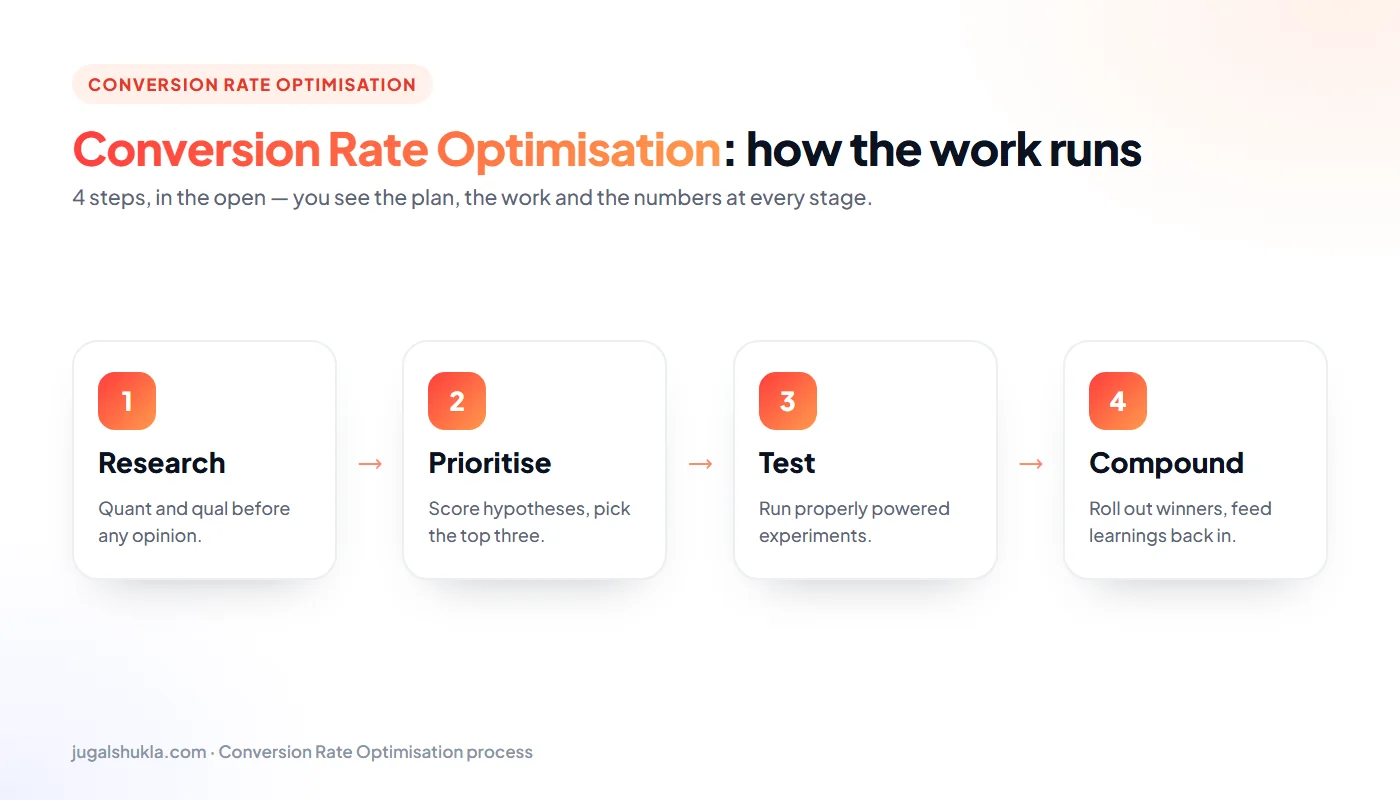
CRO process: Research → Prioritise → Test → Compound
How a Conversion Rate Optimisation engagement runs, step by step.
  1. Research. Quantitative data shows where people leave; qualitative data — recordings, surveys, sales feedback — shows why.
  2. Prioritise. Each idea scored for impact, confidence and ease, so effort goes to the biggest opportunities first.
  3. Test. A/B testing on high-traffic pages; careful before-and-after measurement where traffic is too low.
  4. Compound. Winners implemented, learnings documented and the next round of tests planned.

CRO is cumulative: a series of 10–20% improvements across several steps of the funnel can double the results of the same traffic.

What CRO costs

Conversion rate optimisation is quoted after the Free Growth Call, where we look at your traffic, conversion rates and funnel. A Deep SEO Audit (₹1,999*) also covers speed and on-page issues that hurt conversion, and a Campaign Landing Page (₹4,999*) is often the quickest CRO win for ad campaigns.

Use the free Marketing ROI Calculator to see what a higher conversion rate is worth in leads and revenue at your current traffic.

Timelines and results
  • Weeks 1–2: research and diagnosis; quick fixes for obvious problems.
  • Weeks 3–6: first A/B tests run on the highest-impact pages.
  • Months 2–6: continuous testing; gains compound across the funnel.

Quick fixes — speed, mobile layout, form length, clearer calls to action — often lift conversion within weeks. Bigger gains come from testing offers and messaging over several months.

A/B testing done properly

A/B testing shows two versions of a page to similar visitors at the same time and measures which converts better. Reliable tests follow a few rules:

  • Start with a hypothesis based on research: "Adding delivery dates near the button will reduce hesitation."
  • Test meaningful changes — offers, headlines, layouts — not tiny colour tweaks.
  • Run tests for full weeks to cover weekday and weekend behaviour.
  • Wait for statistical confidence before declaring a winner.
  • Measure the real goal — leads or revenue — not just clicks.

Even "losing" A/B tests are valuable: they show what your customers do not care about.

Landing pages and forms

The highest-impact CRO work is usually on landing pages and forms:

  • A clear headline that matches the ad or search that brought the visitor.
  • Benefits before features, with proof close to every claim.
  • One primary call to action repeated down the page.
  • Short forms — every unnecessary field costs conversions.
  • Alternatives to forms: WhatsApp and click-to-call for mobile visitors.
  • Fast loading — slow pages lose visitors before they read anything.
Trust and proof

Visitors convert when they trust you. Reviews, client logos, case studies, guarantees, real photos, clear pricing and visible contact details reduce risk in the visitor's mind. Placing the right proof next to the decision point — near the form or the "Buy" button — is one of the most reliable conversion rate optimisation techniques.

CRO mistakes
  • Copying competitors' designs without testing.
  • Stopping tests too early on small numbers.
  • Testing trivial details while major problems remain.
  • Ignoring mobile, where most visitors are.
  • Optimising for clicks instead of leads or revenue.
Questions to ask a CRO consultant
  • What research will you do before suggesting changes?
  • How will you decide which pages to optimise first?
  • Do we have enough traffic for A/B testing?
  • Will you implement changes or only recommend them?
  • How will you measure the effect on leads and revenue?
Research methods that reveal why visitors leave

Good conversion rate optimisation starts with understanding visitors, not with guessing. Several research methods work together:

  • Funnel analysis in GA4: where visitors drop out between landing, product or service page, form and thank-you page.
  • Heatmaps: where people click, how far they scroll and which content they ignore.
  • Session recordings: watching real visits reveals confusion, rage clicks and broken elements.
  • Form analytics: which fields cause hesitation or abandonment.
  • On-site surveys: a single question such as "What stopped you from enquiring today?"
  • Sales and support feedback: the questions and objections customers raise before buying.

Free tools such as Microsoft Clarity provide heatmaps and recordings, so CRO research is affordable even for smaller businesses.

Prioritising what to test

Research produces more ideas than any team can test. Prioritisation frameworks score each idea for potential impact (how much it could lift conversions), confidence (how strong the evidence is) and ease (how quickly it can be built and tested). High-scoring ideas go first.

Pages with the most traffic and the biggest drop-offs usually offer the greatest return. Optimising a checkout or main landing page that every customer passes through is worth far more than perfecting a rarely visited page.

Speed and mobile experience

Slow pages lose visitors before they read a word. Research by Google has long shown that the probability of a bounce rises sharply as mobile load time increases. For conversion rate optimisation, the most important speed improvements are compressed images, fewer scripts and plugins, good hosting and caching. On mobile, check that buttons are easy to tap, forms use the right keyboards, nothing covers the content and the main call to action is always within reach.

Pricing pages and offers

Offer and pricing presentation often has more influence on conversion than design. Clear starting prices, what is included, a recommended option, guarantees and answers to common questions reduce uncertainty. Testing different offers — a free consultation versus an audit, a bundle versus single services — can reveal large differences in conversion rate, and these insights also improve your ads and sales conversations.

Checkout optimisation for online stores

For stores, the checkout is where CRO pays fastest. Show total costs including shipping early, allow guest checkout, keep fields to a minimum, offer UPI, wallets and cash on delivery where relevant, display security and returns information, and send abandoned-checkout reminders. Each removed obstacle recovers sales from shoppers who already decided to buy.

Copy and messaging tests

Words often matter more than design. Conversion rate optimisation tests on headlines, value propositions, benefit order, proof placement and call-to-action wording frequently produce the largest gains. Use the language customers use in reviews, sales calls and support tickets; test specific claims against general ones; and make sure the first screen answers what the offer is, who it is for and why it is better. Messaging insights from CRO tests can then improve ads, emails and sales scripts too.

Building a culture of testing

CRO works best as a habit rather than a project. Keep a shared backlog of ideas from research, run tests continuously on key pages, review results monthly and document every learning. Over a year, a steady rhythm of tests — even modest ones — adds up to significant improvements in leads and revenue from the same traffic, and gives your team a far better understanding of what customers respond to.

Personalisation and segment-specific pages

Different visitors need different messages. Returning visitors, mobile users, people from a specific campaign or city, and existing customers can each see tailored headlines, offers or proof. Start simply — dedicated landing pages for major campaigns, location-specific content and different calls to action for new and returning visitors — then test more advanced personalisation once traffic allows. Personalisation is one of the most effective conversion rate optimisation techniques when it is based on real behaviour rather than guesswork.

Microcopy: small words, big effects

Button labels, form hints, error messages and the reassurance under a form — "No spam. Reply within 24 hours." — reduce anxiety at the exact moment of decision. These small details are quick to test and often lift completions noticeably.

How to measure CRO
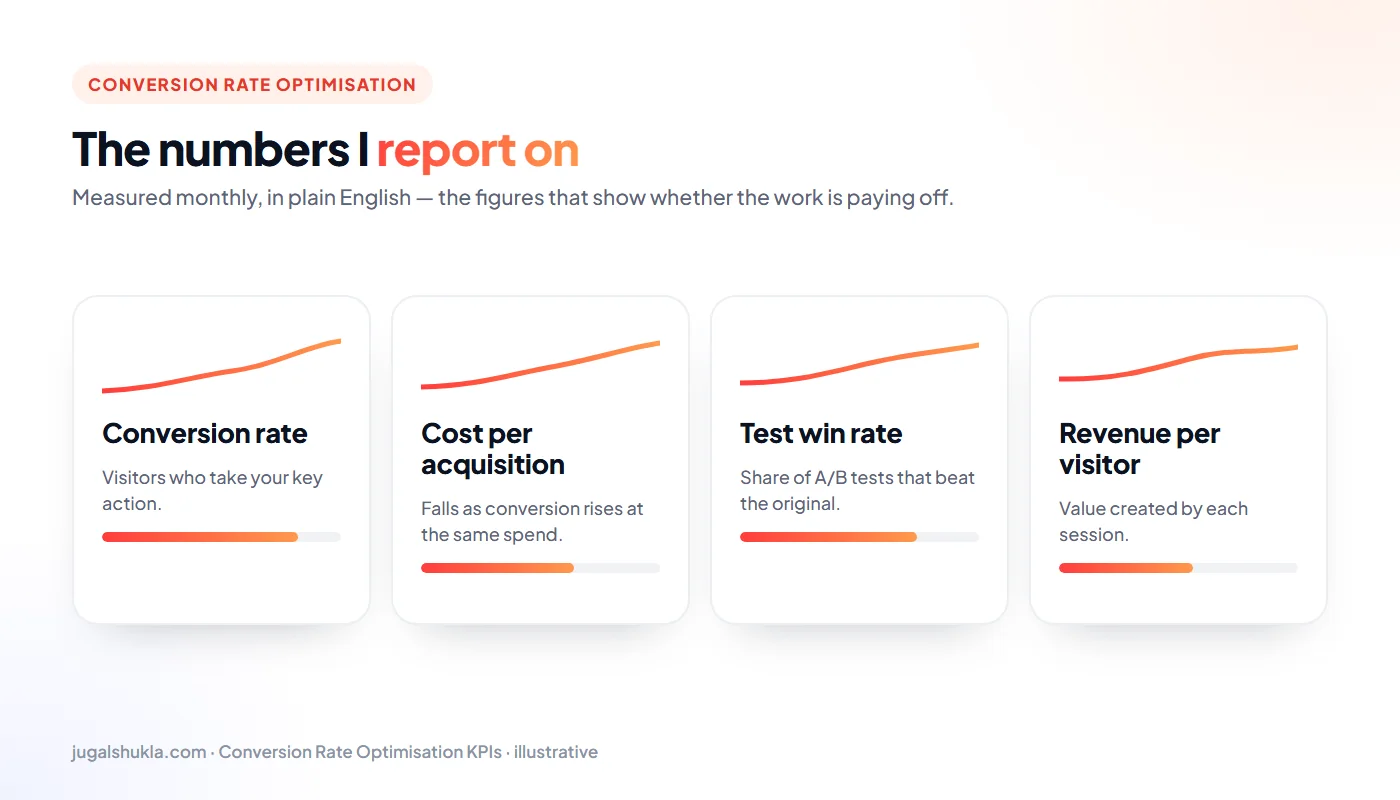
CRO KPIs: Conversion rate, Cost per acquisition, Test win rate, Revenue per visitor
The numbers I report on every month (illustrative).
  • Conversion rate by page, device and traffic source.
  • Cost per acquisition — falls as conversion rises.
  • Test win rate and the cumulative uplift from winning tests.
  • Revenue per visitor — the clearest single measure of CRO impact.

Self-check: open your main landing page on your phone. Within five seconds, can you tell what is offered, why it is better and what to do next? If not, conversion rate optimisation is your quickest win.

FAQ

CRO questions, answered.

11 straight answers to what people ask me most about Conversion Rate Optimisation. Still unsure? Send a quick message — I reply within 24 hours.

Still have a question?

Ask me directly — no bots, no sales team.

How much traffic do I need?

Roughly 10,000 monthly sessions or 300 conversions for reliable A/B tests; below that we use sequential changes.

How long does a test run?

Usually two to four weeks, never fewer than two business cycles.

Do you need developer time?

Light tests I can ship; structural changes need your developer.

What is a good conversion rate?

It varies widely — many lead-generation pages convert 3–10%, and stores 1–3%. The useful benchmark is your own rate improving month by month.

How much traffic do I need for A/B testing?

Ideally a few hundred conversions a month on the tested page. Below that, research-led improvements work better than formal tests.

Which tools do you use for CRO?

GA4, heatmaps and session recordings such as Microsoft Clarity, form analytics and A/B testing tools suited to your platform.

Is CRO better than buying more traffic?

Usually it should come first — improving conversion makes every future rupee of traffic more profitable.

Does CRO affect SEO?

Done properly, no harm — and faster, clearer pages often help SEO.

How quickly will conversion improve?

Quick fixes often help within weeks; testing builds bigger gains over several months.

Can CRO help my Google Ads costs?

Yes. Higher conversion rates lower cost per lead, and better landing pages raise Quality Score.

What does conversion rate optimisation cost?

It is quoted after a free growth call; a Deep SEO Audit (₹1,999*) or Campaign Landing Page (₹4,999*) can be a fixed-price starting point.

Next step

Want a hands-on partner, not a deck?

Tell me what you’re trying to grow. I’ll tell you honestly whether I’m the right person, and what I’d do first.

Send a quick brief

I reply within 24 hours.